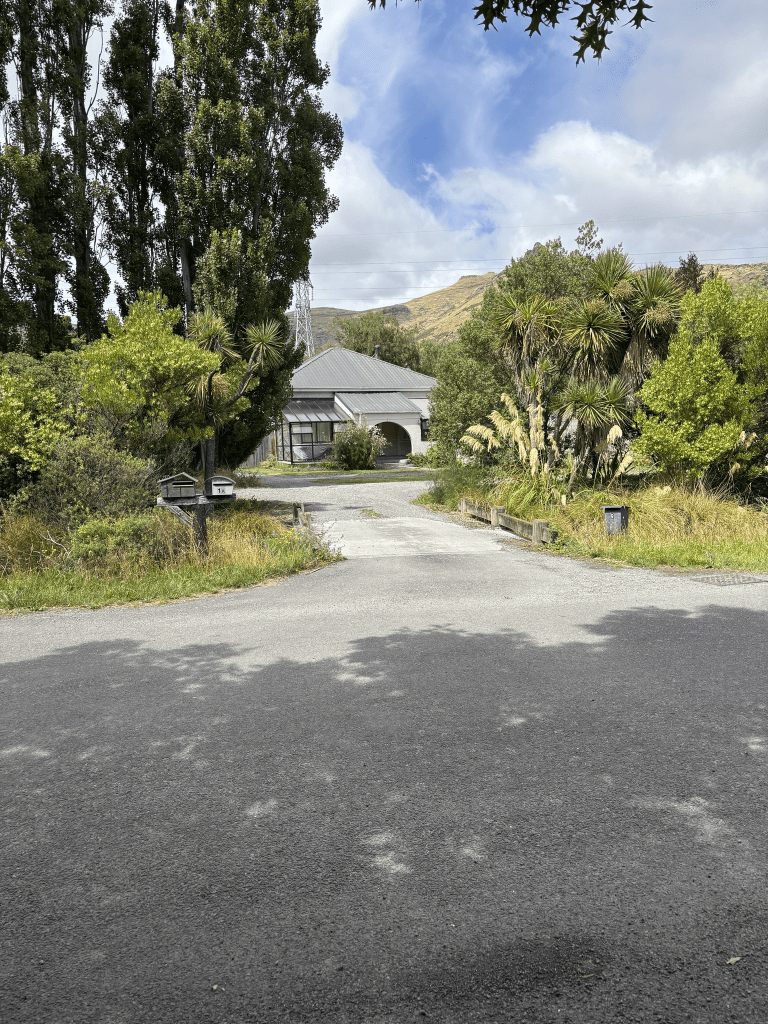
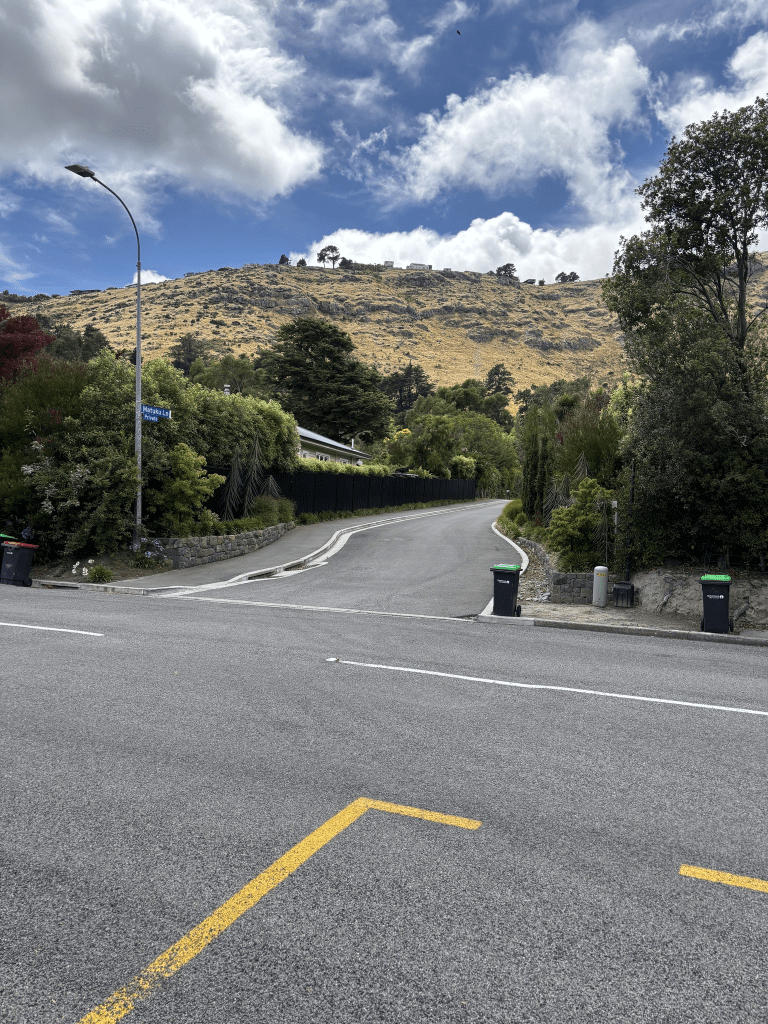
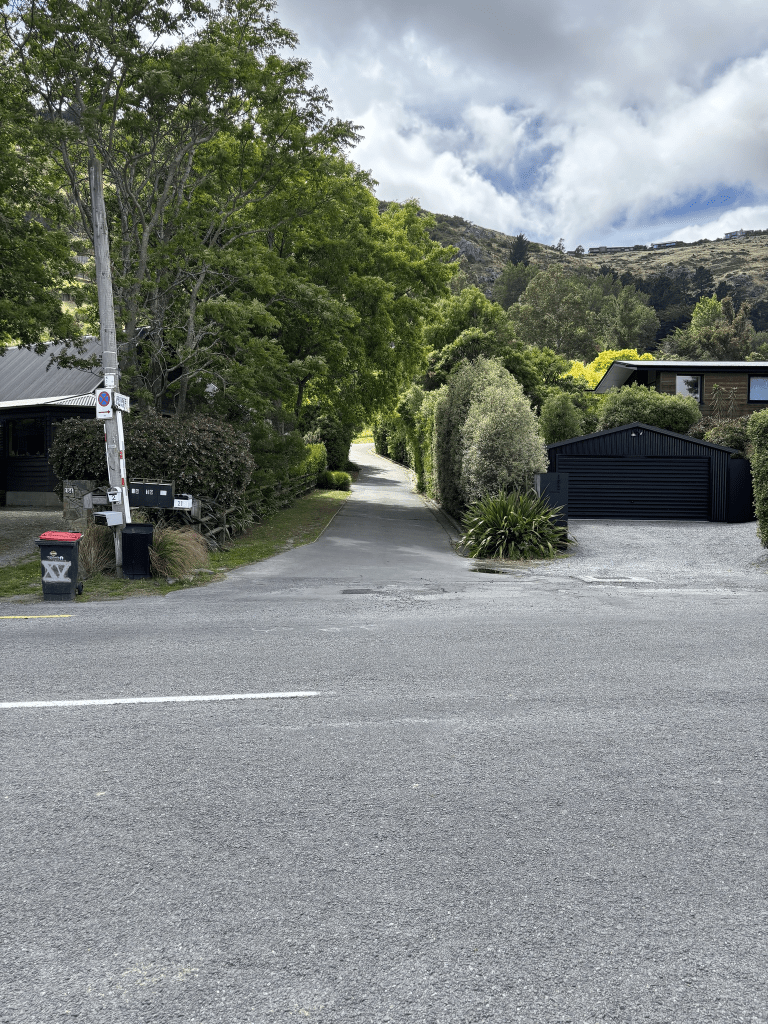
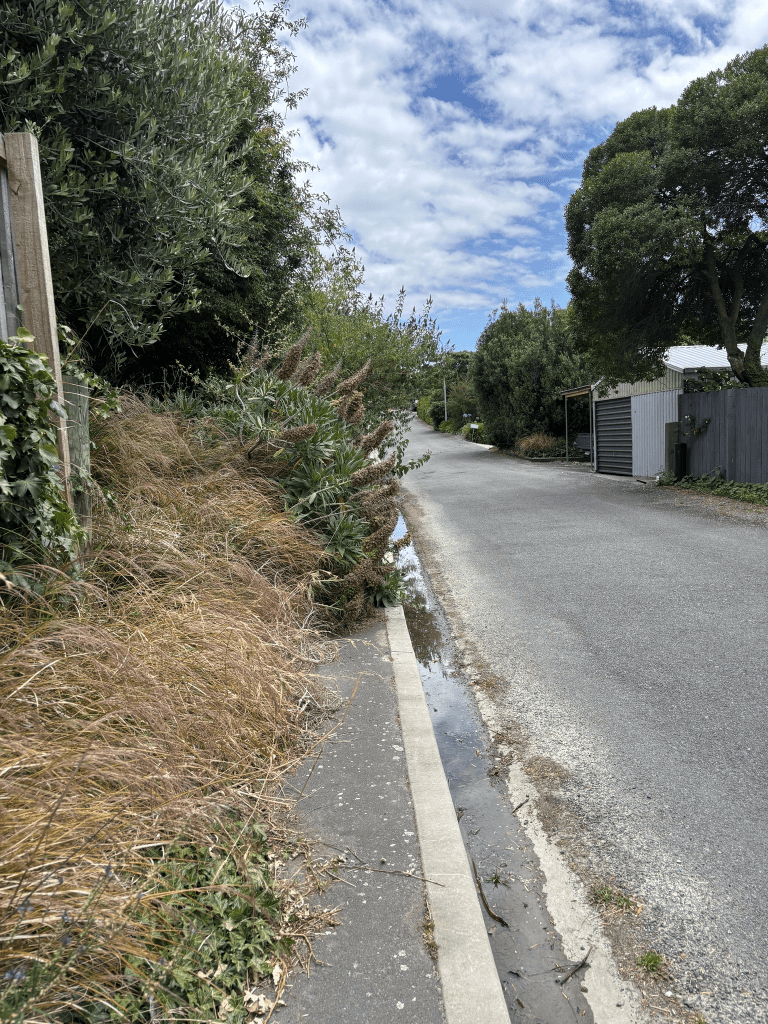
Matuku Lane in Heathcote – Matuku is a te reo Māori name for the white-faced heron. Matuku Waterway is the name of the stormwater drain that runs down the boundary of the development. Matuku is the name of the Council stormwater management area in the valley floor. Matuku, the white-faced heron, (Egretta novaehollandiae) is a medium-sized heron, pale, slightly bluish-grey, with yellow legs and white facial markings. It can be found almost anywhere near shallow water, fresh or salt.
Additional information: Date Named: 16 February 2022 Subdivision: 86 Bridle Path Road
This information was from the new library website and I will confess to being surprised that they had any information. Obviously the old library website didn’t have any information.
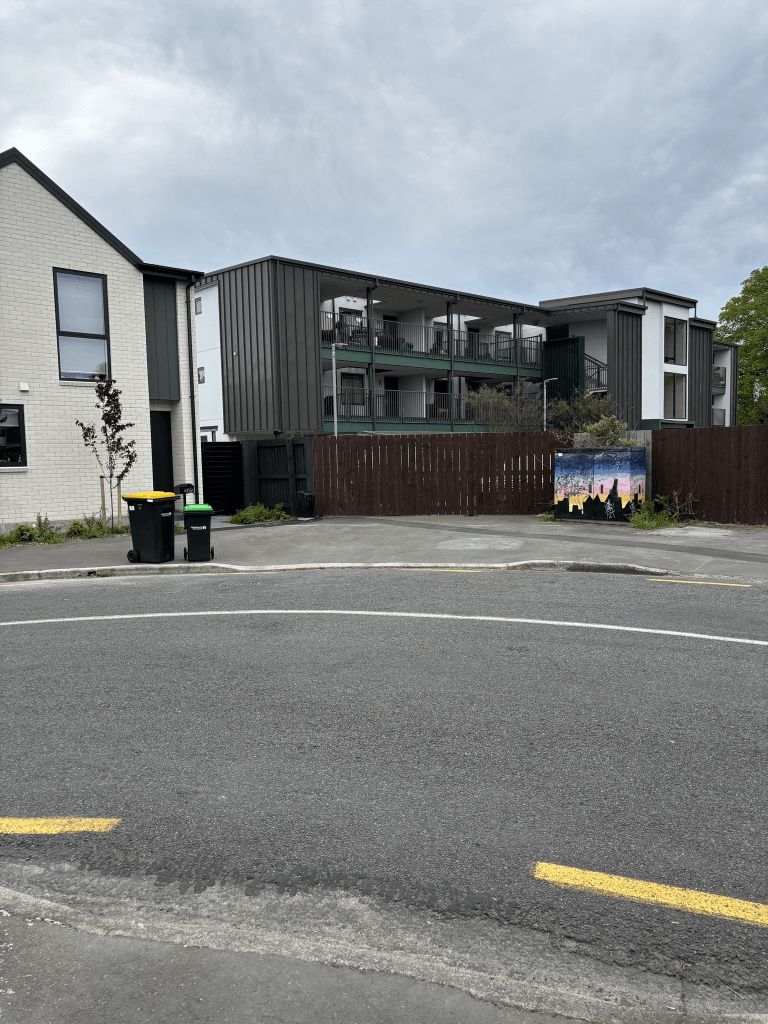
The houses here were built in 2023 and 2024 plus it is still being developed. Only partially walked the street as the footpath is only a few metres long.
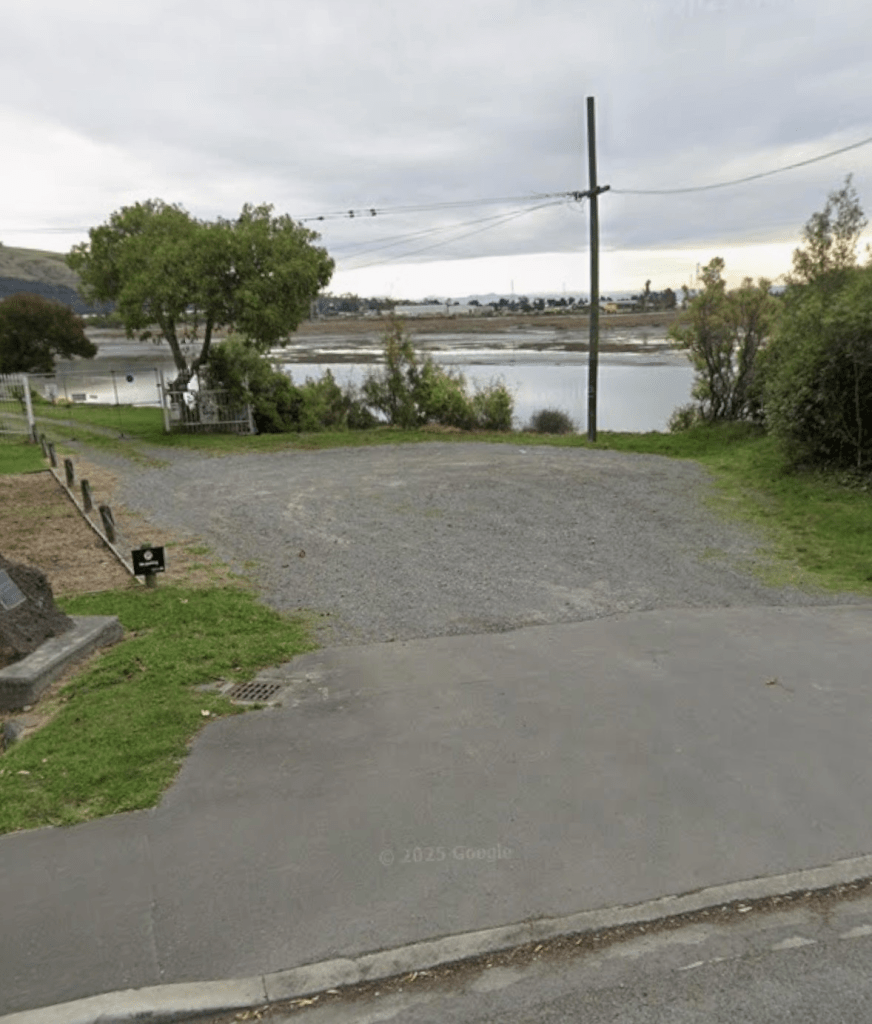
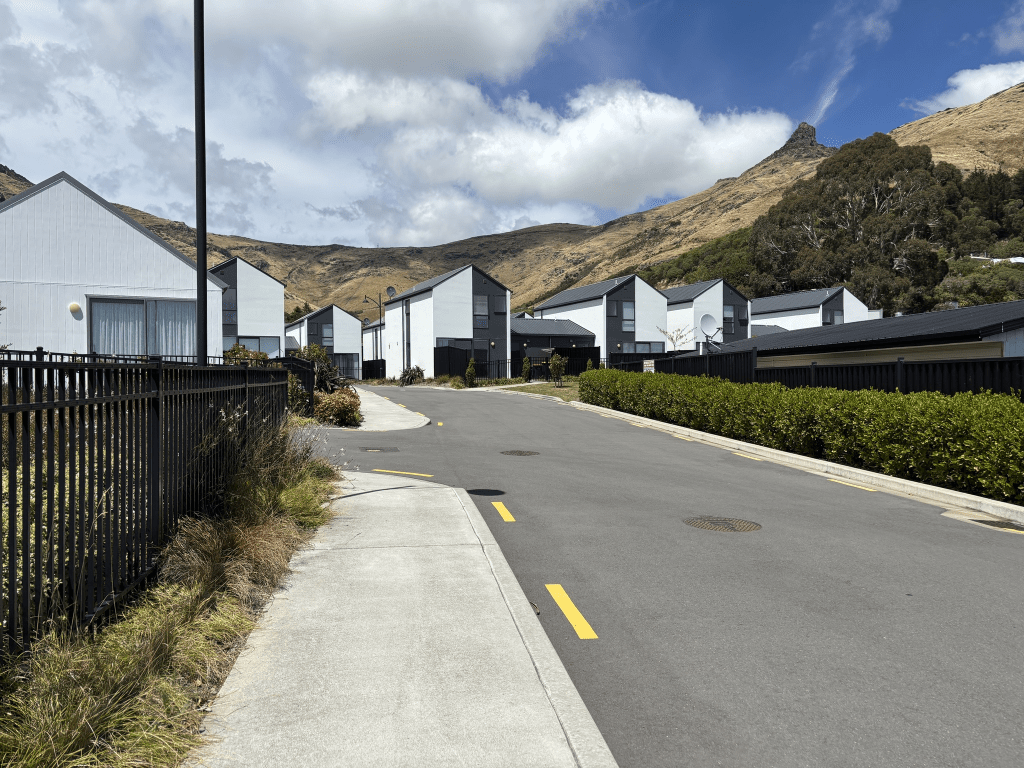
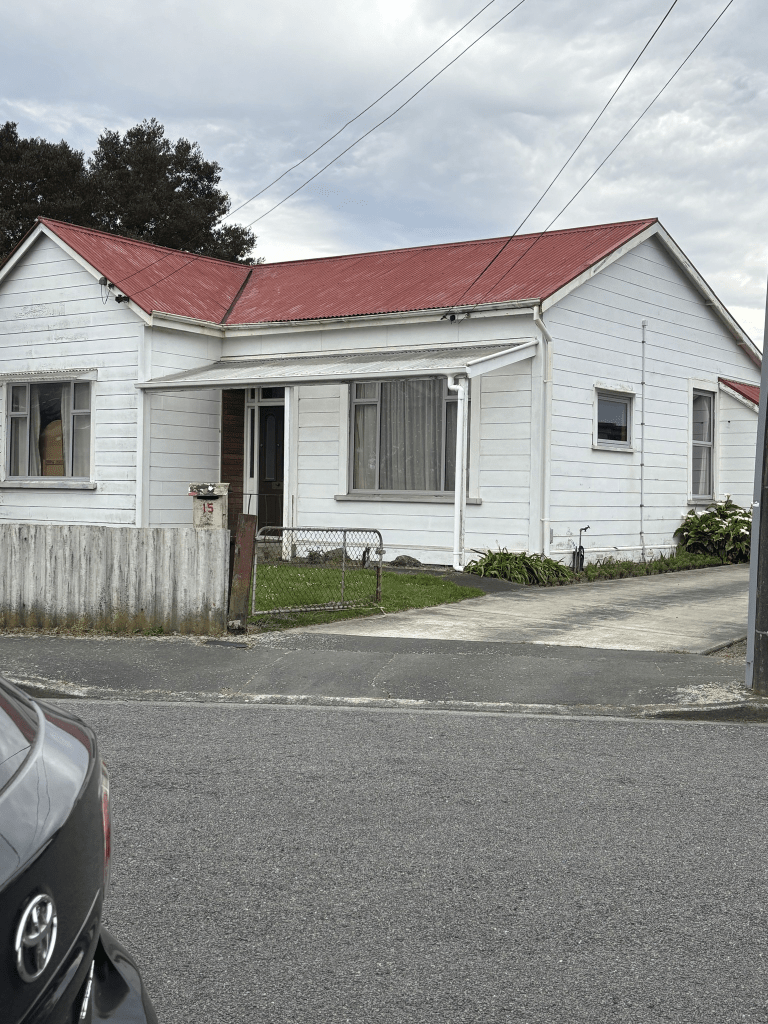
Castleview Lane in Heathcote – Named because the street has a view of Castle Rock. Developed at 162 Port Hills Road. Named in 1999.
A tiny amount of information from the library website. There isn’t anything else that I can add about this street. Most of the houses date from 2000 with one dating from 1980. I am surprised that I didn’t do this street when I walked Port Hills Road. The footpath here is only a few metres long so I only partially walked it. Forgot to get a photo so it is a screenshot from street view.
Hammerton Lane in Heathcote and nothing on the library website. The article Heathcote’s Lovely Lanes by Barrie Wood has the best information. Hammerton Lane takes its name from the 150 acre
Heathcote Valley estate owned by early pioneer Isaac
Cookson. The estate was named after ‘Green Hammerton’ a village in North Yorkshire, England. The name Hammerton was also given to the first ‘township’ in Heathcote Valley, which was located around the area where the Valley Inn is now located. This was part of the original Hammerton Estate and allotments were sold from about 1863. The name ‘Hammerton’ did not endure for the settlement, which eventually became known as Heathcote. Today it is remembered as Hammerton Lane.
Papers Past didn’t have anything for Hammerton Lane. Under Hammerton Green the earliest mention that I found was in 1854 relating to Isaac Cookson’s address. All strange horses and cattle found wandering on the land will be impounded. In 1860 there were ads for the sale of the freehold property Green Hammerton which was 150 acres and included the house and paddocks plus the Inn known as Martins Cottage. in 1862 there was a farewell dinner for Mr and Mrs Cookson as they were returning to England. They were returning to England as their daughter in England was ill. Sadly the daughter died before they arrived back in England.
In 1863 there were sections for sale adjacent to the railway station in the village of Hammerton. Some ads called it the township of Hammerton. Cookson is supposed to be responsible for the first beehives in New Zealand.
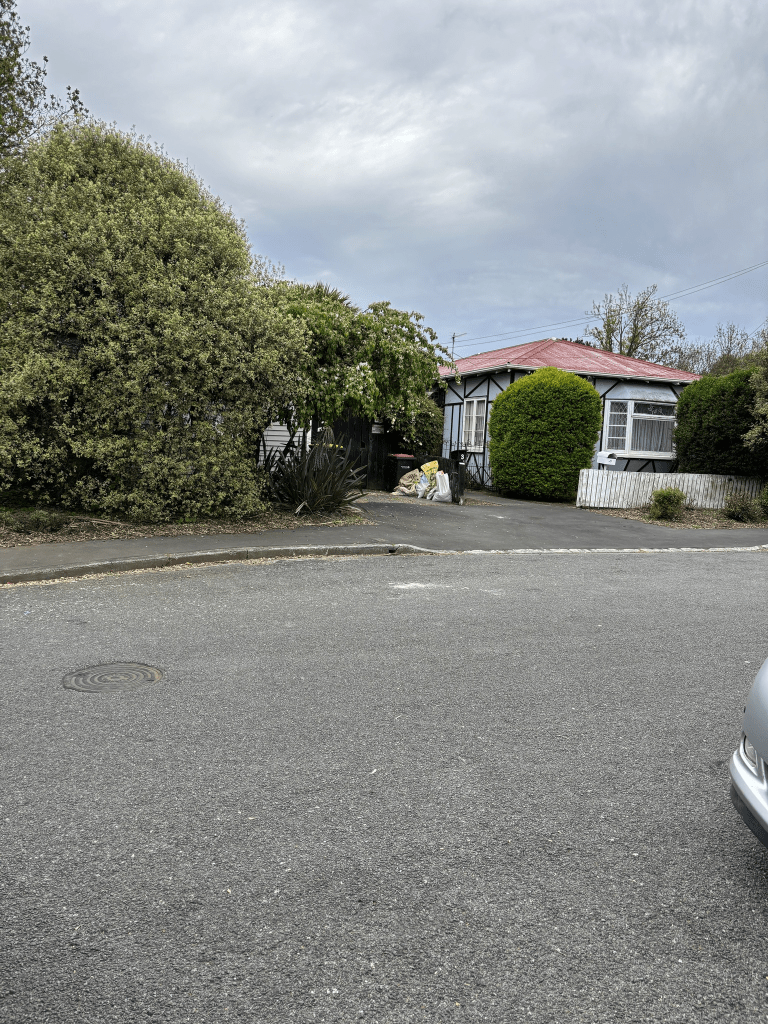
There are only about 4 or 5 houses here on a very narrow lane and I didn’t feel comfortable to walk this tiny lane. Basically the narrow short lane leads to houses which have very long driveways.
When researching Heathcote streets I came across several mentions of The Godley Cross and I found a page with a reasonable amount of information plus an image of the first cross. I also looked at Papers Past. Various articles mention that there had been at least four crosses erected but all were subject to vandalism. The original was erected in either 1856 or 1857. Interesting that this article says that Chaney carved the first cross. He possibly did but the only mention of him carving the cross is in 1864 when he carved a white stone Celtic cross to replace the original cross. There was another replacement cross in 1898 and in 1899 a fence was placed around the cross. Mentioned in 1909,1931 and 1932 with discussion about the vandalism and if it was worth replacing. In 1932 only the pedestal was remaining and this was repaired. A fountain at the same spot was also frequently mentioned but it was decided not to replace it as the water was contaminated by sheep and dogs. I am now going to have to walk the Bridle Path to see if I can figure out where this cross was.
I did walk the Heathcote side of the Bridle Path yesterday and took several photos. On a noticeboard at the start of the walk it is mentioned as being a memorial to women. I reread the information on Papers Past and nowhere is it mentioned as a memorial to pioneer women. It was a way marker to show where the fountain at spring was plus Charlotte Godley said it was for all the early pioneers and she was grateful for the spring. It was also partly a memorial to her husband. By this time she was back in England. I have walked the Bridle Path hundreds of times and I haven’t really considered the history of this monument. I was amused by the younger woman who stopped me to say hello and then tell me that it is a very hard walk and that I probably shouldn’t do it. She told me that she had also stopped an older man who was 80 years of age and told him that he shouldn’t be doing the walk. Note it was the first time that this young woman had walked the Bridle Path. This 71 year old did have a chuckle about the encounter and yes I got to the top and back again without any problems. I was obviously looking old yesterday.
Edited to say that I had really strange coincidence happen to me last week in connection with this monument. I was walking through The Square on my way home after going to the Banksy Exhibition and I stopped to look at the workmen working on the Chalice. They had a wee crane for lifting the leaves into place and I ended up chatting to the young woman who was supervising. I can’t remember how we got onto the subject of the Bridle Path and she mentioned the Charlotte Godley Cross. She was so pleased to find out that I had walked the Bridle Path especially to see the monument. Along with two stonemasons she had done the repair work on the monument last year. I showed her my photos and she pointed out where they had done the work on it. Her work colleagues call her the statue lady. Apparently the grass around the monument was so long that you wouldn’t have seen it before they had done the repair work on it. This encounter made my day.
Vogel Street in Richmond – formerly Tweed street, from Vogel street to Forth street, was incorporated into Vogel Street. Named after John Conrad Vogel (1833-1910). Vogel was a baker and came to New Zealand in 1859. He farmed a block of land fronting onto Worcester Street between the East Belt and Stanmore Road. First appears in the Star in 1881 when land for sale in Vogel Street, Bingsland is advertised. First appears in street directories in 1887. Tweed street, from Vogel street to Forth street, was renamed Vogel street on 24 May 1926.
A small amount of information from the library website and when I walked the street I assumed that it would have been named after Julius Vogel but I was wrong. John Conrad Vogel was born in Hesse, Germany. When he was born Hesse would have been a Grand Duchy rather than part of Germany. He also has no connection to the Vogel bread that is sold in New Zealand.He came to New Zealand on the ship Oliver Lang. He married twice and he died on the same day as his second wife and I had to read the death notices a couple of times to make sure I was reading it properly.
The renaming of Tweed Street to Vogel Street was confusing so I looked at old maps. Took a photo of the 1912 map which clearly shows the streets and it made sense changing that part of Tweed St to Vogel St.
The earliest entry on Papers Past that I found was in 1879 when the council refused to grant a license for a hotel on the corner of Vogel Street and Stanmore Road. In 1884 the Foresters Hall was mentioned. I ended up only looking at articles as there were so many ads and they were mostly for a business in Dunedin. Most entries in 1888 were about something called Richmond Poisoning Case. Lots of death notices over the years and drainage issues were also frequently mentioned. The corner of Stanmore Road and Vogel Street had lots of speakers especially at election time. I don’t know if modern politicians would stand on street corners these days to speak with people.
I walked this street back in October when I was visiting Avebury House as part of Heritage Festival. Parking was a nightmare and I ended up going around the block a couple of times and ended up parking several streets away. The houses here date from 1890 to 2024 and a huge variety of styles. I managed to get a photo of a house from 1915. Some of the older houses were in a reasonable conditions but other ones were looking a bit rundown. Most houses seem to have been built in the 1970s. When I was looking at street view from before the earthquakes I was surprised to see a care home. It has now been demolished and Richmond Market uses the empty section. There wasn’t anything on Papers Past about the care home which was surprising. I walked through this section to get to Avebury House and the market was on so it was very busy. I came back out through the walkway and Vogel Street ends at the corner and Forth Street begins. I would hate to live on this street as parking was a nightmare. One house that has an older looking style is actually a modern house.
Forth Street in Richmond – Probably named after the River Forth in Scotland. First mentioned in street directories in 1902 with a see ref. to Stanmore Road. First mentioned in the Star in 1904 in an advertisement. Not listed in street directories with residents until 1905.
A small amount of information on the library website. There were so many streets in New Zealand with this same street name.
So many entries on Papers Past that I eventually only searched articles which is a pity as ads can often give great information about streets. In 1902 it was described as a new street. Mostly death notices with a few birth notices and during World War I there were ballot notices and roll of honour mentions.
In the 1920s and 1930s there were several birth notices where babies had been born at Nurse Bunn’s house. Elizabeth Bunn died in January 1940. Her mother had died in 1935 aged 82 and her father had died in 1931 aged 80. They had all lived at the same address.
After this date apart from a few death notices there is practically no mention of this street. In 1988 a stolen car used by men who had robbed the nearby supermarket was dumped in the street.
There are still a few older houses left on the street and I managed to get a photo of one of the houses dating from 1910. I wish that I could have managed a photo of the 1905 house but it was hidden behind lots of trees. Most of the houses were built between 1970 and 1990 with a few built more recently.
I actually walked this street back in October and I had been at a Heritage Festival open house at Avebury House. I walked through a walkway to get to this street. Near the walkway entrance on this street there is a painted powerbox. I love street art. I was verbally abused by a local here. He was parked blocking the footpath and I was trying to get a photo of the powerbox. I hadn’t even said anything to him about his parking when he started abusing me. I obviously replied and pointed out that the yellow lines means no parking plus it is a footpath. Apparently the fact that he lives nearby means he is allowed to park on the footpath. Yes I possibly then called him an idiot with an extra adjective attached to the word idiot. Sometimes I have extra fun when out walking.
The newer houses are ugly and the ones from the 1970s and 1980s are nothing startling. One modern place looked more interesting and it would have been built by the developer who does the nicer looking modern places. For some reason one of the older houses had an old red telephone box in the backyard.
Railway Terrace in Heathcote and nothing on the library website. The following information is from Barrie Woods’s piece called Heathcote’s Lovely Lanes. Actually a private right of way, Railway Terrace was named because it follows a terrace above the railway
line. Original properties in this area were part of the Pawaho settlement, which was a government village settlement designed for workmen with jobs in Lyttelton.
The only entry on Papers Past was a death notice from 1994. There were so many entries for streets named Railway Terrace but not for the one in Heathcote. It also doesn’t show on early maps.
There is supposed to be a house here dating from 1900 but I am not sure if I managed a photo of this house as there isn’t any street view on google maps.
There is a footpath on this street but I mostly had to walk on the road as the footpath was overgrown with vegetation. I was expecting lots of history for this street and was disappointed to find very little information. I vaguely recall that I knew someone who had moved to this street after living in Lyttelton for most of their lives but can’t remember who it was.
A tiny amount of information from library website.
The Council are constructing a new road which will provide improved access to Ferrymead Historic Park from Bridle Path Road. The new road runs from Bridle Path Road in to the existing Truscotts Road. Parts of Truscott Road are to be stopped. Truscotts Road will remain as that part following the railway line from Martindales Road, while that part of Truscotts Road near Ferrymead Park will have a change of name to that of the new road being constructed. Various names with an historical connection with the area have been discussed with the management of Ferrymead Historic Park. The name FERRYMEAD PARK DRIVE has been suggested by the Park Management. The name is suitable, and while there is an existing Ferrymead Terrace nearby, there should be no confusion with either emergency services or postal delivery, as there will be no property addresses using the new name apart from Ferrymead Park, and their postal address is a Postal Box. There is ample room on the street map to display the name
I was so pleased to find a link to this information on the council website as it explains everything. Papers Past had nothing for Ferrymead Park Drive but in 1969 and 1972 there were a few entries for Ferrymead Drive where there was discussion about forming a new road with that name to link Bridle Path Road to Truscotts Road.
Google maps and Apple maps also show a road called North Ferrymead Park Drive which is a continuation of Ferrymead Park Drive.
I started at the Bridle Path Road end where there is grounds for Ferrymead Bays Football Club. There isn’t a footpath but the grass verge is fairly wide. The reserve is on one side of the road and the railway line for Ferrymead Heritage Park is on the other side. At the entrance to the Heritage Park there is a bend and it becomes North Ferrymead Park Drive. This takes you to a car park and a mini golf business. There is also access to a walkway here but I didn’t walk it this time but I have previously walked this walkway. I walked back to my car via the reserve.
Truscotts Rd in Heathcote- Formerly Albert Street. May have been named after Albert Charles Truscott (1838?- 1910). Re-named Truscotts Road. Named after Frederick Truscott (1874- 1945) and his wife, Selina Truscott, née Keast, (1875?- 1961). Frederick Truscott, a saddler, was a resident of Pawaho Hamlet in Heathcote in 1905. He farmed Truscott’s Farm, Moncks Spur, from about 1913. His brother, William John Truscott (1870-1941), a farmer, was a resident of the street in 1933 when it was re-named Albert Street. The farm was sold in 1963. It was advertised as “a farm in the city- the best of both worlds” and offered on behalf of the estate of F. Truscott.
A reasonable amount of information from the library website and most of it is rubbish.
I spent ages looking at Papers Past, Ancestry website plus old maps. Nothing on Papers Past about this Albert Street but there were so many Albert Streets in New Zealand including several in Christchurch. Unlikely to have been named after Albert Charles Truscott as he lived and farmed in West Melton. He only moved to Christchurch in 1894 when he was made bankrupt. In Christchurch he lived at 35 Queen Street which later became Union Street. The street was named after Prince Albert who had died in 1861.
The sentence where it says it was renamed Albert Street in 1933 is totally wrong as it was renamed Truscott’s Road. Some of the family were living at Pawaho Hamlet so it is likely to have been named after the family rather than an individual. In 1930s the electoral rolls say that William John Truscott was living in Heathcote Valley and then 24 Maunsell Street. Moncks Spur would be totally irrelevant to Heathcote Valley.
My next problem was to sort out exactly where Truscotts Road ended and Ferrymead Park Drive started. This is where I spent ages looking at maps and looking at Papers Past. I am still confused but have decided to count the street as going from Martindales Road to the intersection by the Ferrymead Heritage Park entrance. Apple Maps have the entire stretch of this road as Truscotts Road. Google maps can’t make up it’s mind and have it as both roads. A map from 1930 has it as Albert Street. From 1940s onwards it is Truscotts Road. More modern maps have the road that goes past Ferrymead Heritage Park as Ferrymead Park Drive but the map from 1983 has it as Truscotts Road. There are no sign posts on the roads to say which streets they are. Confused yet.
History of the street from information on Papers Past. In the 1940s there was only ads. In the 1950s there was one death notice and notices from the Drainage Board. In the 1960s and 1970s most entries were about the rubbish dump but in 1966 there was the first entry about planning a museum on Truscotts Road. In 1971 there was discussion about a new road to connect Bridle Path Road to Truscotts Road and in 1972 permission was given for the road to be built. In 1985 the rubbish dump was to be closed permanently and Ferrymead Heritage Park eventually extended to take over the land where the rubbish dump was sited. In 1988 an injured man who had his feet and hands tied up was found on Truscotts Road near the Ferrymead Heritage Park. At least three people were charged with kidnapping him and beating him up.
At the corner of Martindales Road and Truscotts Road there is a lovely looking wooden church. Then there are a few houses mostly built in the 1980s and 1990s with several more recently built. There is one house from 1915 but you can’t see it from Truscotts Road but I got a good view of it from Deavoll Place.
When you go around the slight bend this is where the maps disagree if it is Truscotts Road or Ferrymead Park Drive. Obviously Ferrymead Heritage Park takes up one side of the road here. On the other side there is a reserve plus car parks. Some maps say this area is called Ferrymead Park. There is a walkway in the reserve plus a wee lake where people sail model boats. I did a loop walk here as I started at Martindales Road end and then cut through Deavoll Place entrance to the Reserve. I had a nice walk through the reserve before returning via the road.
Edited to say that there was only one entry on Papers Past for Truscott’s Farm and that was in the 1880s and was Truscott’s Farm in West Melton. The entries in 1963 for the estate of F Truscott describe that property as Moncks Spur Farm and no mention of it being called Truscott’s Farm.
Edit No Two with information eventually found on council website – Truscotts Road will remain as that part following the railway line from Martindales Road, while that part of Truscotts Road near Ferrymead Park will have a change of name to that of the new road being constructed.
Deavoll Place in Heathcote – Named after Daniel Deavoll (1858?-1929). Deavoll was a carpenter who lived at 123 Bridle Path Road. He named his son, Daniel Stanley Heathcote Deavoll (1898-1974). The family’s fourth generation was still resident in the Heathcote Valley at the time the street was named in 2003.
A small amount of information from the library website. Looked at Papers Past and most entries there were about his death. At least one headline said Old Man’s Death. Daniel died suddenly aged 71 of a heart attack at 6 o’clock in Lyttelton when leaving the steamer Piaka. He had been working on the Piaka. No inquest required as he was known to have heart problems. The only other entries for him were about his wedding and in 1899 he dissolved his partnership in a dairy farm.
Not many houses here and they didn’t stand out but what did stand out was a huge empty overgrown section with a big house bus on the section. There was also an entrance to a walkway so I decided to walk to Ferrymead Park area via this walkway.