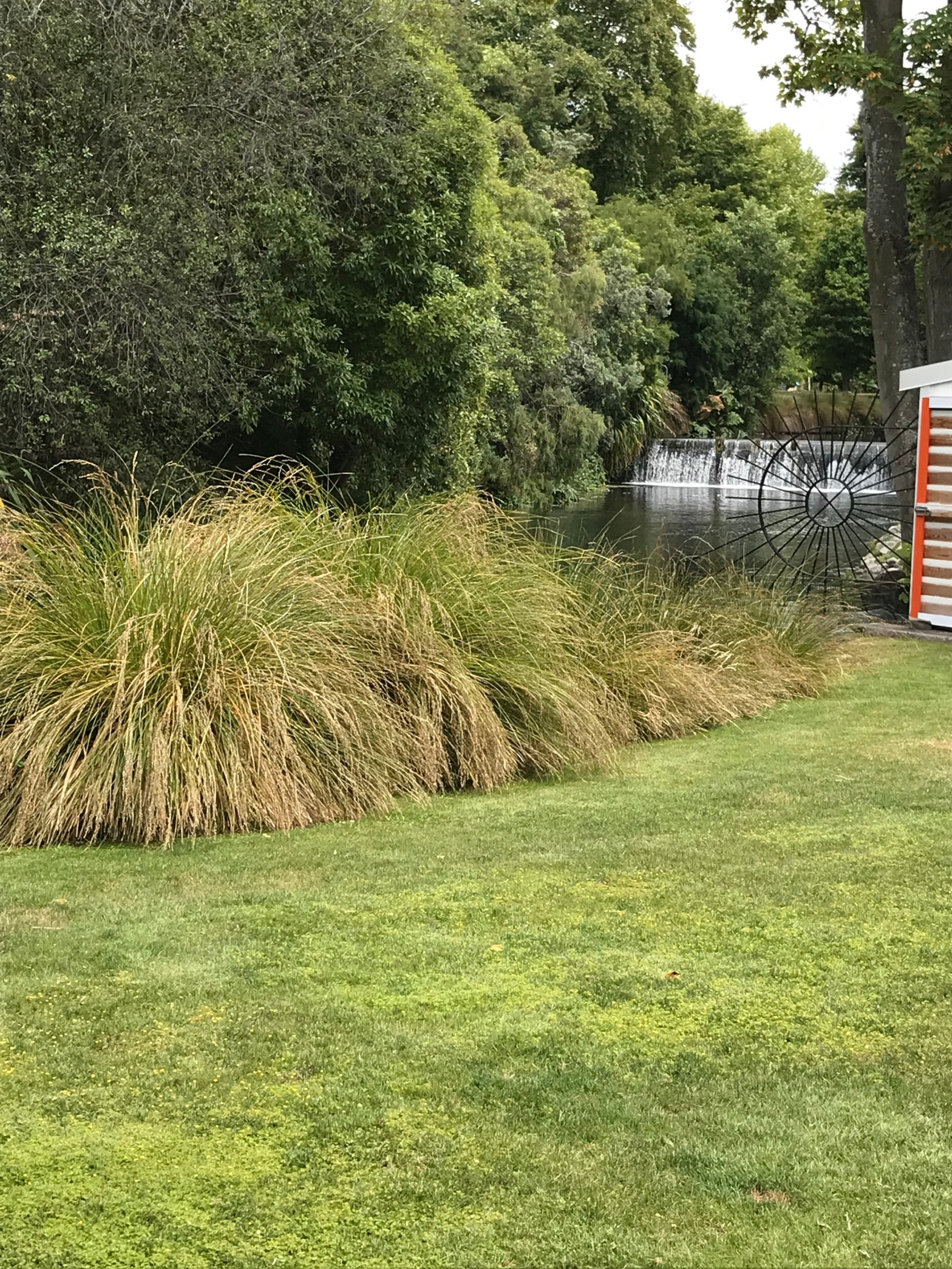
Wood Lane in the suburb of Fendalton, Christchurch

Wood Lane formerly Park Lane -Named after William Derisley Wood (1824- 1904). Park Lane is first mentioned in The Press in 1884 in a report of a meeting of the Riccarton Borough Council. First appears in street directories in 1900. Re-named Wood Lane in June 1948 when 24 streets in the Waimairi County were re-named. Wood set up a flour mill at the end of this lane

A reasonable amount of information from the library website. This information confused me as I was only aware of the mill on Wise Street in Addington. The Cyclopedia of New Zealand and Peeling Back History has much more information about this man and the mills. William Wood arrived on the Randolph in 1850. He went back to England where he purchased a windmill to bring back to NZ. He set up a mill which was called Riccarton Mill. This mill had a fire in 1971 and was demolished in 1974. Girls High School is built where the mill used to be. The mill on Wise Street in Addington was an additional mill for him. Apparently the only thing left of Riccarton Mill is a weir and I realised that I took a photo of it without knowing what it was. William Wood is buried at Linwood cemetery.

Several new houses being built here and there were workmen everywhere. A couple of older houses here.Not sure that I would like to live here even if it is a lovely area as I think that you would be at risk of flooding.

Heathfield Avenue in the suburb of Fendalton, Christchurch

Heathfield Ave formerly Heathfield Road -Named after Heathfield, the property of William Cuddon (1834-1924). Land belonging to Cuddon, a brewer and maltster, was sub-divided into 32 sections in 1913 and auctioned. A house was built there for Geoffrey Ernest Fitzhardinge Kingscote (1889?-1949), an accountant, and his wife, Florence Agnes Placida Kingscote, née Humphries, (1889-1975), ready for Kingscote’s return from serving in the army during World War One. The house was demolished in 2000. Heathfield Road is first mentioned in The Press in 1913. Is Heathfield Avenue in a death notice in The Press in 1917. First appears in street directories in 1918.

A reasonable of information from the library website and there is nothing that I could add to it except that the library have this street in the suburb of Mairehau which is totally wrong. This street is in the heart of Fendalton and is at least two suburbs away from Mairehau.

The Cyclopedia of New Zealand has more information about William Cuddon if you want to know more about him. The library have a shorter version under Early Residents of Fendalton. I liked the bit where it said that he was popular with his neighbours because he had a private bowling green. I am assuming that they were allowed to use it.

Found articles on Stuff from 2017 and 2018 and this street is apparently the most expensive street in Christchurch. Well beyond my budget.

Hard to see some of the houses because of high fences. Some amazing houses but a couple were fairly average. There was one place that had a wee bridge over the stream to get to it but it was taped off so I suspect that it will be getting repaired or demolished to make way for a new build.I am also assuming that the huge place with security camera signs is the house that was mentioned in one of the Stuff articles.
I was amused by wee wooden structure on the footpath as it was a toilet.A pleasant wee street and this mature woman wearing a backpack walking on the street would probably be considered suspicious. I don’t do handbags.

Ridgeway Place in the suburb of Richmond Hill, Christchurch

Ridgeway Place  Nothing on library website –

I have no idea where I got the following information – Ridgeway lies just south of the South Yorkshire border and is 5 miles south east of Sheffield. Ridgeway is a self-contained village around 700 years old and would once have been part of Sherwood Forrest.

Note there are several places called Ridgeway in the UK but as the original developer George Humphreys was from Yorkshire it is possible this is why the street was given this name.

When I walked this street last year there was only one or two houses that had been built.

Cecil Wood Way in the suburb of Richmond Hill, Christchurch

Cecil Wood Way – Named after Cecil Walter Wood (1878-1947). Wood was an architect responsible for a number of the houses on Richmond Hill. First appears in street directories in 1981.

A small amount of information from the library website and I can’t add anything to it. A tiny street with 3 or 4 houses that were built in the 1980s

Elgin Street in the suburb of Sydenham, Christchurch

Elgin Street – Formerly part of Fifth Street. The streets south of, and parallel to, Moorhouse Avenue were named in numerical order. Re-named Bowen Street. Probably named after Sir Charles Christopher Bowen (1830- 1917). Re-named Elgin Street. The section of Fifth Street west of Colombo Street through to Durham Street was re-named Bowen Street in 1881. The council made this section a public street on 10 October 1892. Re-named Elgin Street on 7 March 1904.

A reasonable amount of information from the library website and nothing that I add to this. Elgin is a place in Scotland.

A short street with shops at the Colombo St end. A few businesses mostly connected the the car industry on this street. The Colombo Mall car park is on this street and takes up most of one side of the street. There are a couple of cafes near the Durham St end. There is one lovely old building here. My favourite shop would be the Steampunk shop and the woman who owns it has a teapot mobility scooter. I don’t personally do Steampunk but love their stuff.

Antrim Street in the suburb of Sydenham, Christchurch

Antrim Street -Named after County Antrim, one of six counties forming Northern Ireland. Named in 1927 at the request of the estate of W. Walls, the owner of the land subdivided to form the street.

A small amount of information from the library website. I am not sure why it is called Antrim as the headstone for William Walls says that he is from Co Derry. It is possible that his wife is from Antrim.

Information from Papers Past. William Walls was former landlord of Cambridge Hotel and had also been landlord of Sandridge Hotel. He died in the Port Hills in 1889 by shooting himself by accident when climbing through a fence. He was only 48 years old and an article said that he left a wife and 10 children.

His wife Elizabeth died in 1926 and the sections were offered for sale in July 1927 with a note saying new street known as Antrim Street. William and Elizabeth are buried at Addington.

This is a small street with a mixture of new and old houses and there was at least one empty section when I walked this street.

Milton Street in the suburb of Sydenham, Christchurch

Milton Street – Cowper Street was incorporated into Milton Street. Appears as Restell’s Road on an 1879 map. Named after John Pain Restell (1825-1885) who owned a farm there which was subdivided in the late 1870s. Milton Street was named after John Milton (1607- 1674); Cowper Street after William Cowper (1731-1768). One of the “poets and writers” streets of Sydenham, Addington and Waltham named by a committee of the Sydenham Borough Council on 19 January 1880. Both Cowper and Milton were English poets. Milton Street and Cowper Street both first appear in street directories in 1887, Cowper Street running off Milton Street. Cowper Street was incorporated into Milton Street in 1889.

A reasonable amount of information from the library website. Probably nothing that I can add to this.

There are shops at the Barrington St end of this street. Many older wooden villas here on this street with occasional slightly newer brick houses. Between Selwyn St and Colombo St there is an entrance to Bradford Park. In this area there are some more modern houses plus 1970s style of flats. At the Colombo St end there are a few businesses and I was amused by the one flying a skull and crossbones flag. One building looked like it could be an historic building.

Buchan Street in the suburb of Sydenham, Christchurch

Buchan Street – Named after John Buchan (1875- 1940). Queen Street first appears in street directories in 1887. Re-named Buchan Street on 1 September 1948 when 120 streets were renamed. Buchan was a novelist, publisher and politician. Continues the theme of “poets and writers” streets of Sydenham, Addington and Waltham named by a committee of the Sydenham Borough Council on 19 January 1880.

A reasonable amount of information from the library website. Without looking it up I would guess that there were too many streets called Queen Street which is why it was renamed.

John Buchan was one of my favourite authors when I was a teenager but haven’t read any of his books in years.

This is a business district and too many businesses for me to name but the AA would be the most obvious one. There are back entrances to those new apartments on Brougham St here.

There is the Buchan St playground and it is very sad to see how rundown this is looking. The old school bell that was here has disappeared but the plaque regarding it is still there.

When I worked at the old ANZ (before earthquakes) I used to enjoy eating my lunch in this park. I wouldn’t want to do this now. The play equipment is so neglected and I can’t imagine that it be that safe for children.

Browning Street in the suburb of Sydenham. Christchurch

Browning Street  – Formerly Lytton Street. Named after Baron Edward Bulwer Lytton (1803-1873). Re-named Browning Street. Named after Robert Browning (1812-1889). Lytton was an author. One of the “poets and writers” streets of Sydenham, Addington and Waltham named by a committee of the Sydenham Borough Council on 19 January 1880. Re-named Browning Street on 11 October 1954. Browning was a poet.

A small amount of information from the library website and I can add nothing to it.

This street had houses of every style you could think of. A couple of Art Deco flat roofed style from the 1930s/ 1940s. Ugly modern blocks of flats plus houses from 1960s to the 1980s. There were 2 or 3 that looked much older and could be original houses. Some were well kept and others were looking rundown. A weird street as it looked as if it was part of three other streets.

Battersea Street in the suburb of Sydenham, Christchurch

Battersea St – Formerly part of Third Street. The streets south of, and parallel to, Moorhouse Avenue were named in numerical order. Re-named Battersea Street. Probably renamed after St. John’s Training College at Battersea, England.

The section from Harper Street to Colombo Road was re-named Battersea Street officially on 2 August 1880, when the Street Naming committee of the Sydenham Borough Council recommended that “Second, Third and Fourth streets be respectively named Sandyford, Battersea Gladstone streets, these being the names under which they are dedicated to the public, and which were chosen by the first residents in those streets. St. John’s Training College at Battersea, England, was founded in 1844 to supply superior teachers for Church of England schools. It had associations with the Canterbury Association. A former principal, Thomas Jackson was, briefly, Bishop-Designate of Lyttelton. Ex-student John Bilton was sent out as a schoolmaster and the Cathedral organist designate. Battersea Street is in an area where a number of streets have associations with the Church of England.

A lot of information from the library website and there is nothing that I can add.

This is in the business area of Sydenham and many of the businesses are connected to the car industry. Still a couple of empty sections and there is a pub at the Colombo St end. Nothing stood out for me here.