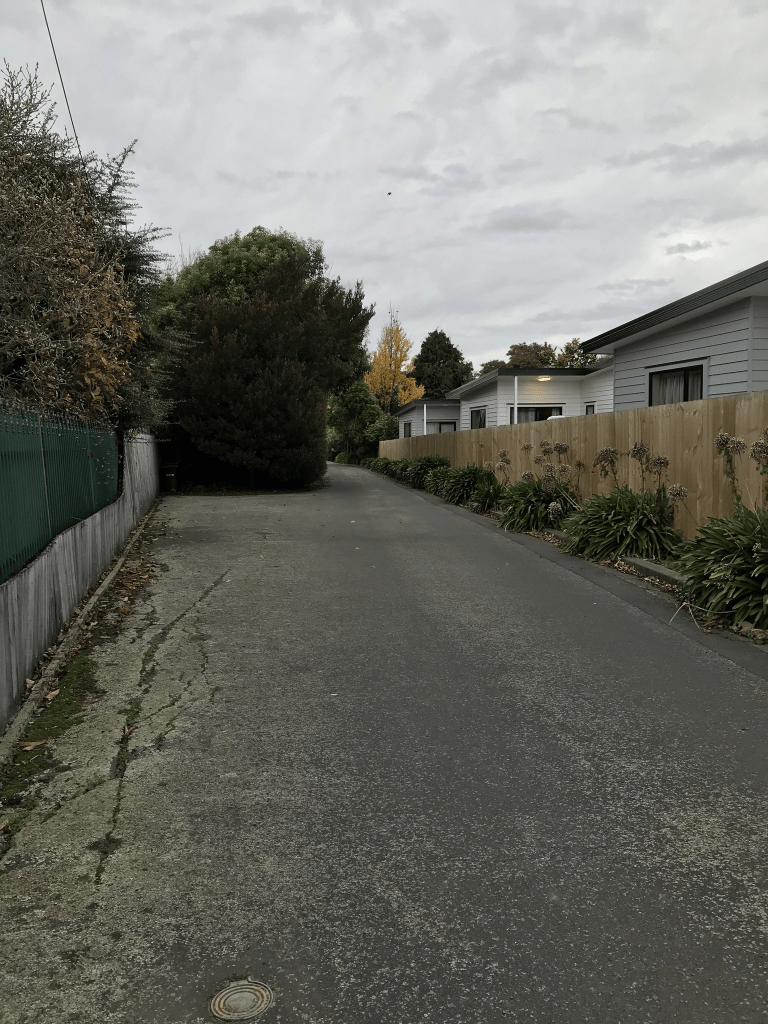
Bluebell Lane in Woolston – Named to continue a theme already established in the Brookhaven subdivision. In a subdivision by Enterprise Homes. Named in 1999.
A tiny amount of information from the library website and this lane is nowhere near the subdivision which has the rest of the themed street names.
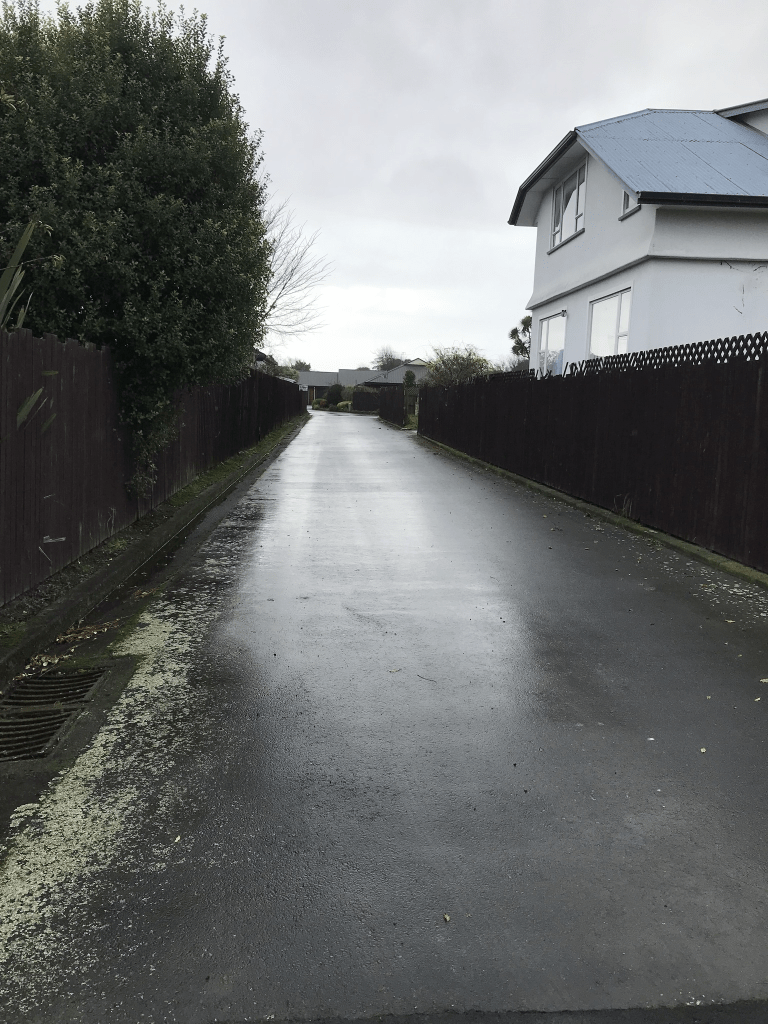
It is a tiny private lane that I didn’t actually walk as there wasn’t a footpath.
Arthurson Mews in Woolston and nothing on library website about the street. I couldn’t find out the reason for the street name and it sounds like a person’s surname. I checked Ancestry website and cemetery database but couldn’t find anyone with that surname living in Christchurch. The street has been developed at 43 MacKenzie Ave and the houses were built in the 1990s.
Ravenna St in Avonhead – Probably named after Ravenna, a city in the Emilia-Romagna region of Italy. First appears in street directories in 1966.
A tiny amount of information from the library website and nothing that I can add about the name of the street. Most houses were built in the 1950s and 1960s. There was also several built in the 1990s and 2000s and they looked like they were possibly what used to be called over 60s units. Papers Past had several ads in 1960 for sections in a a new subdivision. In 1957 it was described as a new street and crown lease land. There was a shop on the corner of Ravenna St and Avonhead Rd that was mentioned frequently and it just as frequently changed it’s name. In 1959 it was called Cain’s Foodmarket and in 1962 in was Winder’s Foodmarket. In 1965 it was called McLeans Foodmarket and in 1968 it was Rawstorn’s Foodmarket. By 1977 it was Ravenna Dairy. These days it is a hairdressers.
There wasn’t really anything that stood out for me in this street. A few nice gardens.
Rosedale Place in Avonhead – nothing on library website which was surprising as the houses were built in 1960s and 1970s. I couldn’t find out how the street got it’s name. Papers Past mostly had ads for the sale of houses and sections. The sections were for sale between 1967 and 1969 and usually described as exclusive. The street was frequently entered in the best street and garden competitions.
I had been geocaching nearby and walked this street to get back to my car. There is a walkway from Maidstone Road to this street. It seemed like a pleasant street and would be especially lovely in spring when the trees that line the street are in blossom. Most houses were typical for the 1960s and 1970s but a couple were a bit different. Most gardens were nice but nothing really stood out for me.
Conway St in Somerfeld – Named after Conway Lucas Rose (1817-1910).Rose and his family arrived on the Midlothian in 1851. He purchased Rural Section 76, 700 acres on the “Lower Lincoln Road, Heathcote Bridge” in partnership with Frederick Spencer, 4th Earl Spencer (1798-1857). He served as a magistrate for the Province of Canterbury in 1853. He later returned to England and died in Chard, Somerset. Sewell’s journal says: Although he had more capital than most settlers, he was unenterprising, did not farm and built a large house in Manchester Street, Christchurch. Spencer’s interest in the land was passed on to his nephew, the Hon. George William Spencer Lyttelton (1847- 1913). First mentioned in The Press in 1880. First appears in street directories in 1906.
A large amount of information the library website. There is a mistake in the library information as the Conway St mentioned in 1880 isn’t this street. There was another Conway St which was in Sydenham. Not much information on Papers Past about Conway Lucas Rose.
Because this is an older street there is a huge amount of information on Papers Past but nothing before 1907. A large number of death notices. Between 1907 and 1918 most entries are about farming type of activities. Pigs, heifers, sheep, horses and hens are some of the animals mentioned. In 1918 a two acre paddock was for sale and in 1919 there were building sections available on a two acre property being divided up. In 1935 residents complained about dust and noise from council trucks taking rubbish and spoil to the pit on Lyttelton St. They wanted the trucks to use Frankleigh St as that is sealed or seal Conway St. In 1954 there were state sections available by ballot. As usual with these ballots returned servicemen have preference. One sad entry was in 1947 where a resident from this street was injured in the Ballantynes Fire.
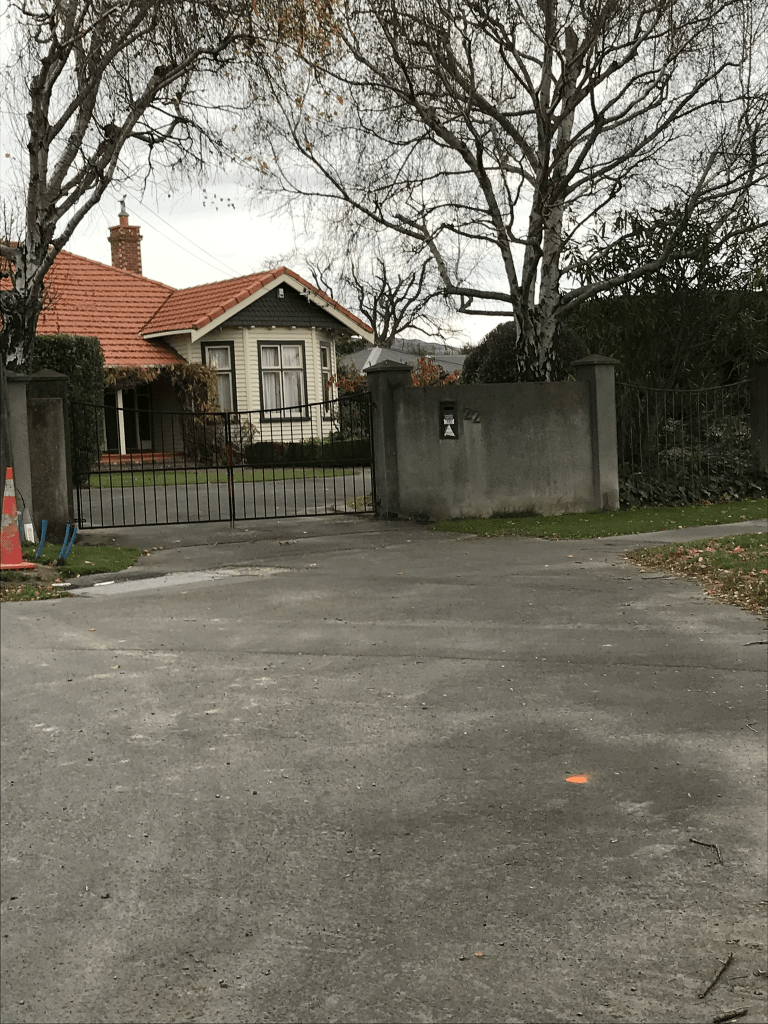
There are 166 houses on this street and they cover every decade from 1910 to 2022. There is a surprising number of houses from 1910s and 1920s. Most are lovely wooden villas in good condition. One house from 1910 is a flat roofed house and not the normal style for that era and I was expecting it to have been built in the 1940s. The houses from 2022 do not fit in with the rest of the street.
Deloraine St in Somerfield – Named on 29 March 1956. [An earlier name tentatively approved but not pursued was Delamain Street.]
A tiny amount of information from the library website. There is a street in Yaldhurst with the name Delamain and the Delamain family lived in Yaldhurst. The only Deloraine that I could find was in Tasmania and it was named after a character in a poem by Sir Walter Scott. The poem was called The Lay of the Last Minstrel.
Papers Past had an entry about it being a new street in 1956. The vicarage for St Nicholas Church was at 10 Deloraine St and there were several entries about it. Several death notices plus engagement notices. The street had flooding issues in 1978.
I was looking to buy a house in 1978 and remember looking at one on this street but when I walked this street I couldn’t remember which house I had looked at. The flooding issues probably put me off.
Most houses here were built in 1950s and 1960s and none of them stood out for me. I wasn’t even inspired to take photos.
Strauss Place in Somerfield – Part of Frankleigh Street. Probably named after the Strauss family. The Strauss family was an Austrian family renowned for its musical compositions. First appears in street directories in 1987.
A small amount of information from the library website and nothing that I can add about the name of the street.
Apart from some death notices on Papers Past the main articles were about the change of the street. In 1983 the eastern part of Frankleigh St was renamed Strauss Place.
I remember when Frankleigh St was altered as it was my main route when driving between Lyttelton and Hoon Hay. Strauss Place was part of Frankleigh St until they decided to line up Frankleigh St with Milton St. I can’t remember if one or two houses were demolished on Barrington St to create the deviation.
Out of the 22 houses here three of them were built in the 1920s and the one that I loved was built in 1910. There is now a cycleway that goes through this street.
Roberta Drive in Somerfield – In a subdivision developed by Maurice F. Carter Ltd. The name has no particular significance. It just “sounded nice”. Named in 1960. Information about naming supplied in 2009 by Maurice Carter (d. 2011) in an interview with Margaret Harper.
A small amount of information from the library website and nothing that I can add the name of the street.
Most entries on Papers Past seemed to be about best street competitions. There were sections available in 1962, 1962 and 1968. It was a new street in 1960 in the new subdivision off Lyttelton St. There were flooding problems in 1968 and 1974. In 1989 there were trees to be removed because of root damage to the footpaths.
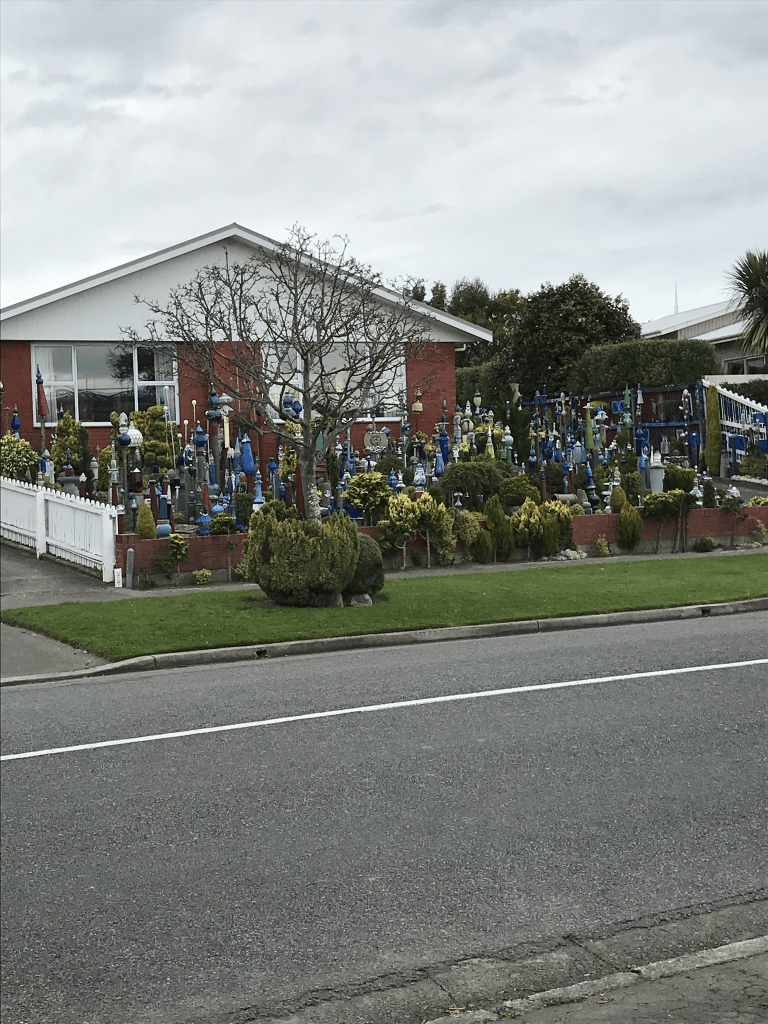
This is a pleasant street and most houses were built in the 1960s. None of the houses were were particularly outstanding in styles but they were set in nice gardens. There was one very interesting garden with the most amazing garden decorations.
Nina Lane in Somerfield – Named after the Nina, one of the sailing ships in Christopher Columbus’ voyage to America in 1492. Developed at 86 Conway Street. Named in 1999.
A small amount of information from the library website and nothing that I can add about the name of the street.
There are only 5 houses here built in 1990. This was a narrow lane with no footpath and I didn’t walk it.
Merle Place in Somerfield – Named after Pauline Merle Carter (1915- 2008) Merle Carter was the wife of Maurice Carter, builder and developer. He developed and named this street. Named in 1960.Information supplied in 2008 by Maurice Carter (d. 2011) in an interview with Margaret Harper.
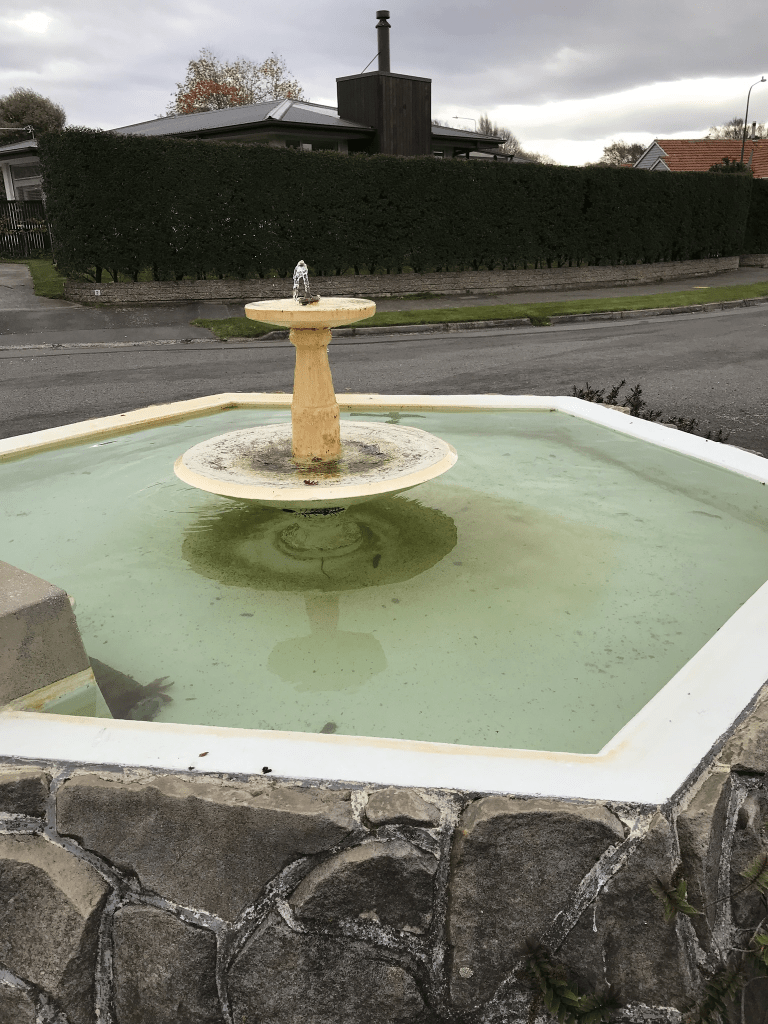
A small amount of information on the library website and nothing that I can add about the name of the street. Not a huge amount of entries on Papers Past. In 1960 it is described as a new street in a subdivision off Lyttelton St. It was frequently in the best street and garden awards in the 1970s. In 1962 the residents requested that they build a fountain in the street and the committee from Council and Drainage Board raised objections. The residents eventually were given approval for the fountain and it is built over the main sewer but the sewer is still accessible. Any issues with the fountain to be the responsibility of the residents.
The 6 houses here were built in the 1960s and the houses didn’t really stand out for me but I did only have eyes for the fountain. I did like the fountain plus the street had a footpath on both sides of the street. I love it when I come across streets like this.