Bishopsworth Street in Hillsborough and nothing on library website. This was rather surprising as I found the street mentioned in Papers Past as early as 1911 when channelling and asphalting the footpaths were done. In 1914 there was a house and a large section for sale and it was on the corner of Grange St and Bishopsworth St. Several sections and new houses for sale in the 1950s and 1960s. The street also appears on a map of Christchurch dated 1912. Between 1917 and 1918 there were a couple of ballots where this street was the men’s addresses. These ballots relate to men being called up to serve in the war. My best clue was in 1919 where Mrs F Cooksley had received a notice that her husband would be returning home to New Zealand. Ancestry was a big help here and Frederick Cooksley had been a brickworker in the nearby brickworks and sadly his brother died after being crushed at the brickworks. Frederick eventually became a market gardener on Bishopsworth St. The father John Henry Cooksley was a carter and he transported the stone from the brickworks and a nearby quarry. The Cooksley family lived on Grange St and Bishopsworth St runs off Grange St. John Henry Cooksley’s mother was Sarah Gadd and the original name for Curries Rd was Gadd Rd after Sarah’s brother Elijah Gadd. The Cooksley family had a connection to Bristol and there is a place called Bishopsworth in Bristol.
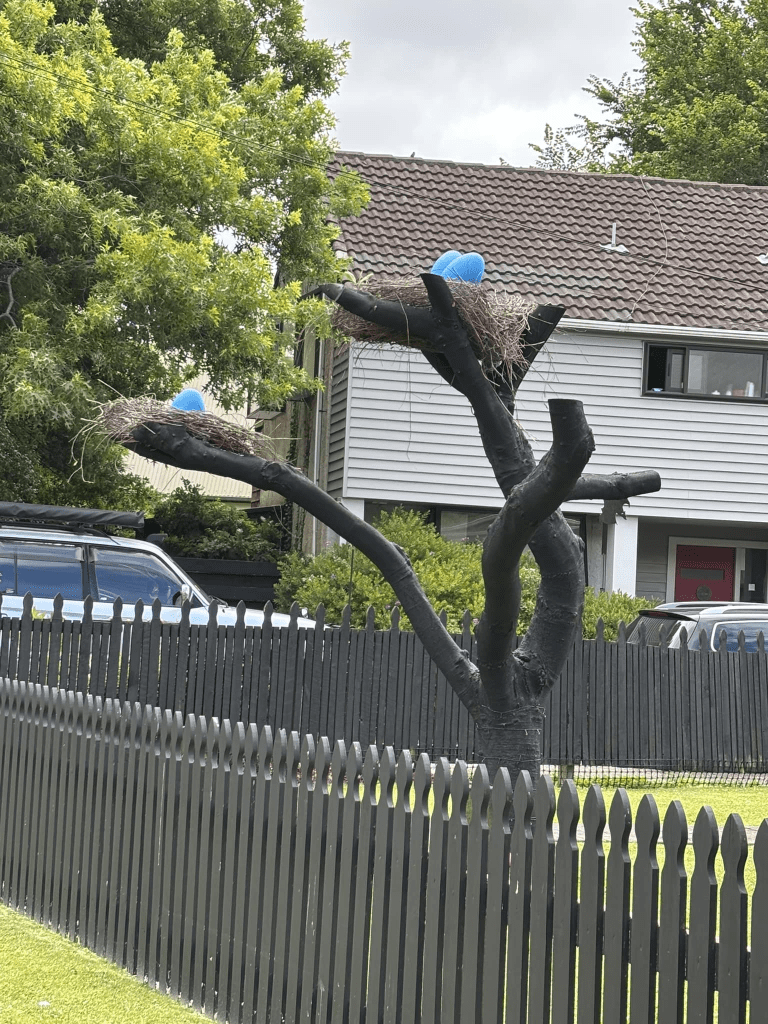
There is one house here that dates from 1930 but most houses were built between 1950s and 1980s. This is a pleasant tree lined street and on one side a big portion is taken up with Hillsborough Park. I am so sure that this park used to have more trees than what it now has. On the other side some of the houses have a hill behind them and this seems to be where some of the newer houses were built between 2013 and 2016. There was one house that I really liked and the house itself was fairly ordinary but it had a skeleton in the window. I am not the only nutter in Christchurch with skeletons. I also liked the tree in the front yard as it had been partially chopped down but in the remaining branches they had built a giant nest and put large blue balls in the nests.
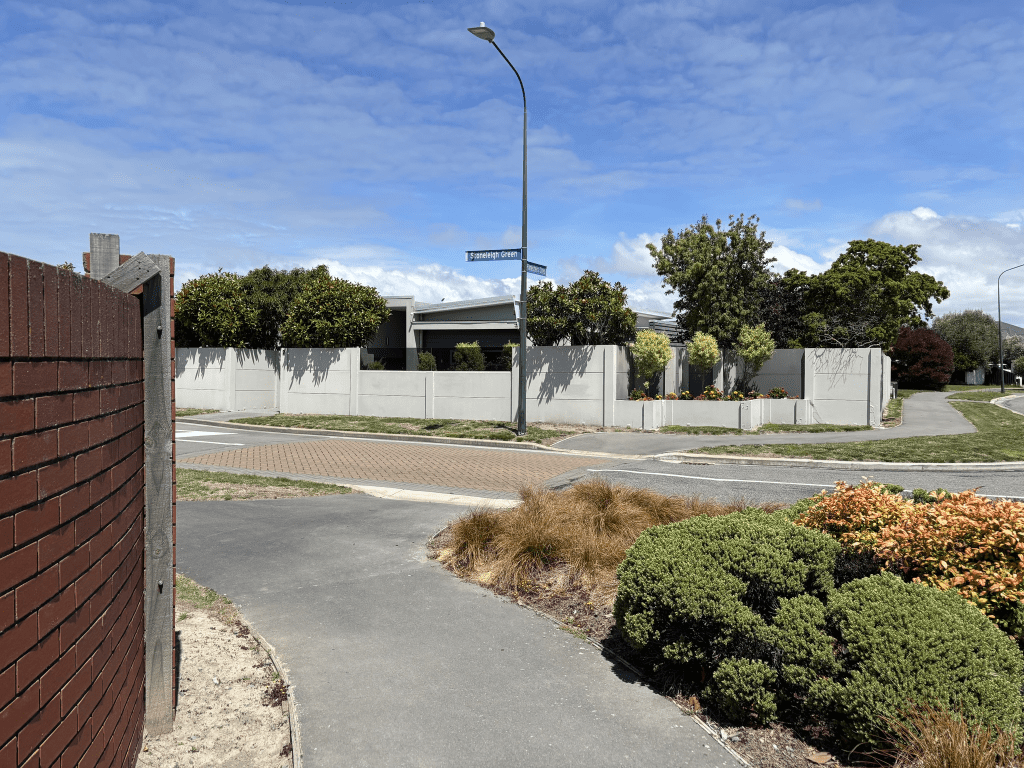
Stoneleigh Green in Parklands – The Community Board commended the developer, Smith Developments Ltd in its use of a forestry theme when naming streets in the Forest Park Estate subdivision. Named in 2004.
A small amount of information from the library website. There are lots of places in the UK called Stoneleigh and leigh means a woodland clearing in Old English.
This is a tiny street next to Crofts Reserve with only 7 houses but the houses are fairly large and built in 2000. Footpath on only one side of the street. There is one brick house which has it’s brick fence /wall propped up by wooden props as the there is a bit of a lean to the wall. I looked at street view and it has been like this since the earthquakes. It actually looked like a pleasant street.
Linkwater Way in Parklands – Name proposed in 2002. This is from the old library website street information. Then I decided to look at the new library website information – Forest Park Estate Smith Developments Limited Name proposed in 2002. The street would link Bottle Lake Drive and Lamorna Road.
I then found this information on an archived council page from 2002 – That the Board ask Smith Developments Limited to choose a name from the list of approved Maori street names to substitute for Linkwater Way.
As the street is still Linkwater Way the developers obviously ignored the council. I don’t know what waters the street is linking without trying to find a map of the various waterway.
I am not sure why I didn’t take photos here as I quite liked the street. The houses were all different styles and many had nice gardens. There is an entrance to Arthur Adcock Memorial Reserve here and I am now wondering if the large boulder in the middle of the reserve used to have a plaque on it.
Foresters Crescent in Parklands – The Community Board commended the developer, Smith Developments Ltd in its use of a forestry theme when naming streets in the Forest Park Estate subdivision. Named in 2004
A small amount of information from the library website and I couldn’t found out any more information. Most houses here were built in 2000 but a few were built later. When I looked at street view comparing the latest street view with older street views it looks like there were some houses demolished after the earthquakes.
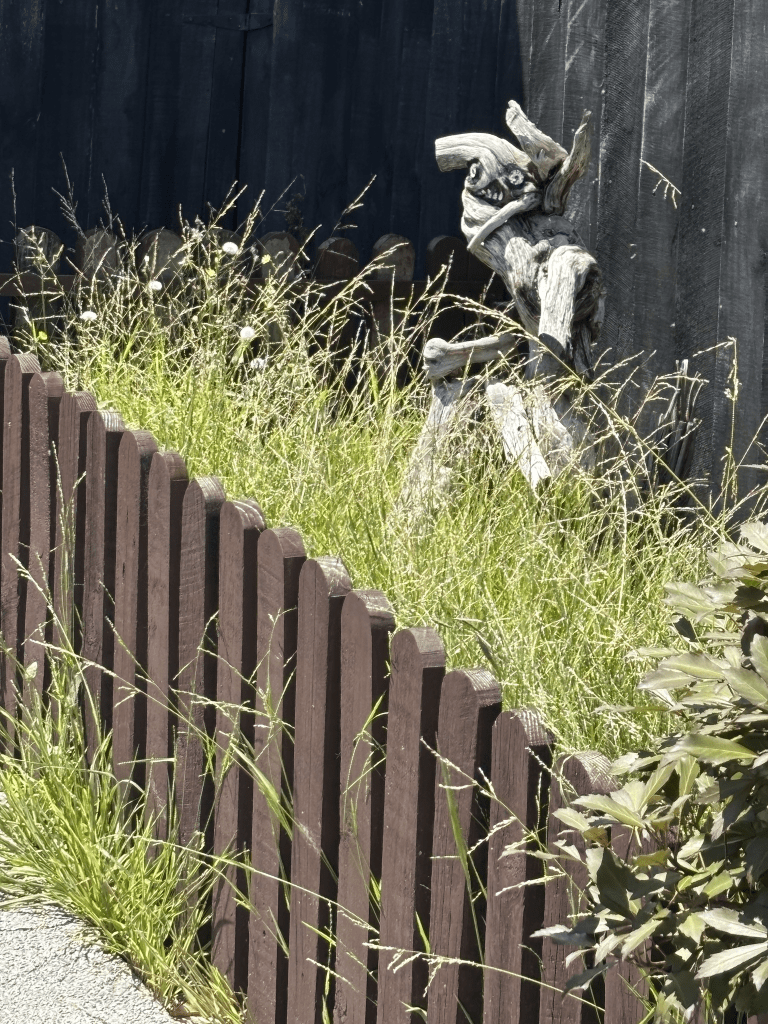
It looked like a pleasant street with a footpath on both sides of the street. A few had nice gardens but it was mostly immaculate lawns with shrubs. There was one garden which had a piece of driftwood that I liked.
Crofts Lane in Parklands – First appears in street directories in 1995. A tiny amount of information from the library website. I couldn’t find out any more information about this street. When there is an S on the end of a street name it usually means that it is named after someone. There is also a Crofts Reserve. This was a private lane so I didn’t actually walk it as it looked like it was a driveway. There isn’t a street view for the street but looking at google maps it seemed to show a walkway leading to the reserve. I was in the reserve and I didn’t see a walkway here. The valuation website said that there are 14 houses here which were built in 1990 and 2015. That is more houses than I expected as it only looks like there are about 5 or 6 houses here.
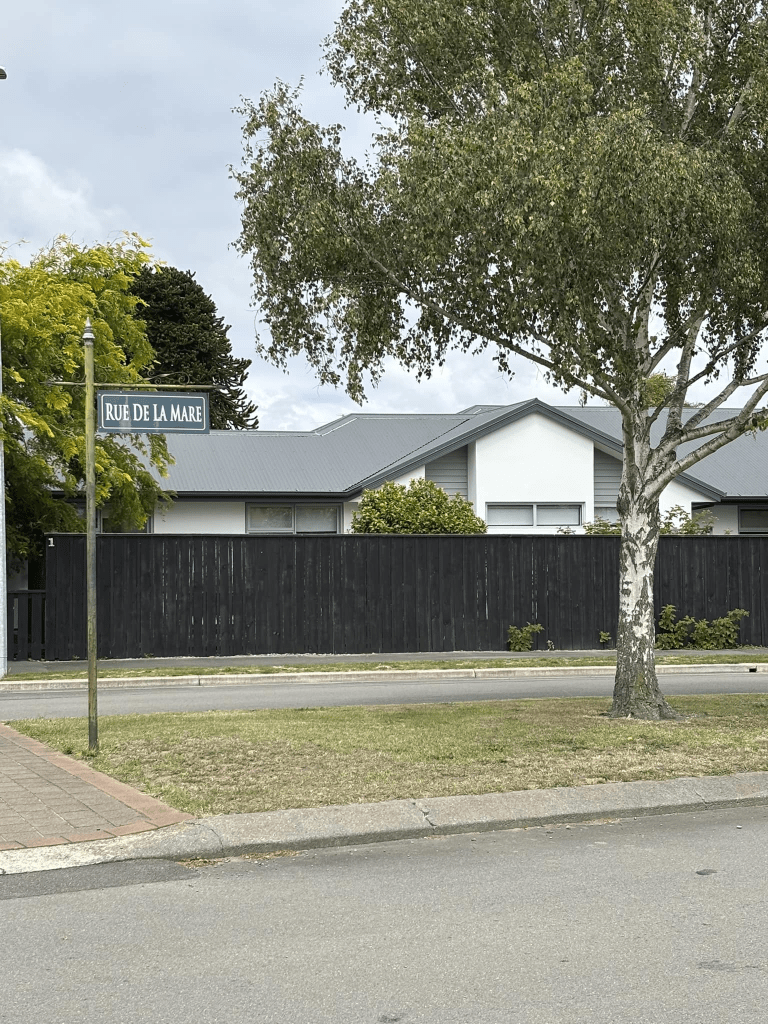
Rue De La Mare in Parklands – Named after Ronald Cyril de la Mare (1925- 1975). De la Mare was the managing director of the Bower Egg Farm Ltd., 467 Bower Avenue. Formed post-1997.
The information from the library website is totally wrong and sent me down a weird rabbit hole. Ronald Cyril de la Mare AKA Delamare had what looked like a complicated domestic life. The Bower Egg Farm was set up in 1954 by Cyril John de la Mare from Guernsey. Cyril came to New Zealand in 1953 with his wife Joan and sons Roger and David. Roger was running the Bower Egg Farm when it went into liquidation in 1998. Cyril eventually went back to Guernsey where he died in 1975 aged 66. The electoral rolls have Cyril John de la Mare living at 467 Bower Ave with occupation as poultry farmer. As usual many of the family trees on Ancestry website were confusing. Ronald de la Mare AKA Delamare father’s name was also Cyril so many people have muddled up the two families. I found an article on Papers Past from 1968 about the Bower Egg Farm being the largest in New Zealand. The article said that Mr Delamare set up the egg farm when he emigrated to New Zealand from Germany. In the same article it mentions that he had farmed eggs in his home town of Guernsey. This shows that our reporters have always struggled with geography as they are certainly rather challenged in this department these days. The Guernsey connection explains why Rue was used in the street name. I couldn’t find the council details for the naming of the street.
The street had a footpath on both sides of the street which I like and the street is in a T shape. A very tidy and pleasant street but nothing stood out so no photos. The houses here were built in 1990 and 2015. The gardens were almost too tidy but a few had shrubs rather than just immaculate lawns. There was an entrance into Crofts Reserve here and the reserve had a playground plus a wildflower garden. I quite liked the street. Edited to say that I am an idiot as I did take a photo of this street.
Tunnel Road in Ferrymead and I obviously didn’t actually walk this one. Too dangerous plus I would probably be arrested if I attempted to walk it. Nothing on the library website for this road. It is 5km long and goes through at least three suburbs. I have driven this road frequently. There is a Wikipedia page for the Road Tunnel and this road is mentioned. You can’t really separate the Tunnel Road from the Road Tunnel. Huge number of articles in Papers Past starting in 1920. Many of the articles and letters to the editor were about which was the best option for transport of goods to Christchurch. There were three groups and one wanted a canal and this would have followed Linwood Ave with wharves near Lancaster Park. Then there were the ones who wanted a port to be built in the estuary at McCormacks Bay. Obviously the ones who wanted a tunnel through the hills won this battle. Before 1900 there was a bit of talk about a tunnel from Sumner under Evans Pass but engineers decided against this. One of the arguments against the tunnel was the risk of earthquakes and that the tunnel would be blocked by landslides and that it would be impossible to dig out the trapped people. From 1950s onwards a lot of the articles and letters to the editor talked about traffic would be too busy for Lyttelton. The Road Tunnel was on TV in September 1961 when there was a ceremonial blast at the Heathcote end of the tunnel. This was attended by the Prime Minster Keith Holyoake. The Tunnel Road was constructed at the same time as the Road Tunnel was being constructed. In the 1960s the arguments were about the maintenance of the tunnel and the Tunnel Road. The Road Tunnel Board had to pay for the maintenance as the National Road Board refused to have responsibility for it. This is why there was a toll for driving through the tunnel. I can’t remember when you no longer had to pay tolls. I have just googled and it said that the 20c toll was abolished in 1979. I remember having a bag of coins in my car for the toll. I am also old enough to remember when the toll was a half crown coin.
We used to walk up the hill to the Summit Road and were able to see the Tunnel Road being built. We used to walk up what we called the Old Hikers Track and is now called the Major Hornbrook Track. The hills above Lyttelton were our playground and we thought nothing of roaming the hills even at a young age. The tunnel was opened in 1964 and I would have been 10 years old that year. I can’t remember if I went to opening ceremony and I am fairly sure that we didn’t walk through the tunnel as many people did. We did drive through the tunnel when it was first opened. We possibly didn’t walk through the tunnel as my Mum was probably not well enough to do this.
The Tunnel Road goes from Ferry Road to the Road Tunnel entrance and going by Papers Past there were lots of accidents. There are still accidents happening on this road.
Curries Rd in Hillsborough and Woolston – formerly Gadds Road and Station Road. Formerly Station Road. Becomes Station Road and Gadds Road. Named after Elijah Gadd (1832?-1888). Re-named Curries Road. Named after Mrs Mary Currie, a resident in Station Road from 1892. Station Road first appears in street directories in 1892. From 1905-1928 it is listed as Station Road or Gadds Road (one entry). Gadd established the earliest Hillsborough brickworks and also built Christchurch’s first wooden town hall in 1859. He died in Sydney. Station Road or Gadds Road was re-named Curries Road in 1933 by the Public Utilities Committee of the Heathcote County Council. Gadd’s dates of birth and death supplied in 2007 by an Australian descendent, Christine Gadd, in an interview with Margaret Harper.
That is a reasonable amount of information from the library website. For further information I looked at Papers Past, Ancestry and Findagrave. The earliest mention that I could find on Papers Past was in 1900 for Gadds Rd and channelling was done in 1902. One more mention in 1919. After this date the street seemed to be known as Gadds Rd and Station Rd. In 1932 the name was changed from Station Rd to Curries Rd and reason was that there were too many Station Roads. I will agree with this as it was almost impossible to search for Station Rd as there were so many of them in Christchurch and there is still one in Heathcote.
There is a mistake in the library information as Elijah Gadd didn’t build Christchurch’s first wooden town Hall in 1859. He was a stone mason plus he didn’t arrive in New Zealand until 1862. What he did do is rebuild the Town Hall in stone in 1862 / 1863 but this building was destroyed by an earthquake in 1869. In 1866 he bought land in Hillsborough where he established a brickworks plus a large orchard and garden. He also was one of the first licensee of the Heathcote Valley Hotel and in 1877 his brickworks was available to be let. In 1876 and 1879 he applied for a license to run a pub in Hillsborough. I found an entry dated 1957 where his brick and stone two storey building on the corner of Curries Rd and Opawa Rd was to be demolished. This was where he planned on having his pub. In 1882 he returned to Australia. He had originally emigrated to Australia from Somerset before coming to New Zealand. I got a bit confused about his wife as I found a death notice for Sarah Ann Gadd in 1871 and she died aged 31 plus I found a death notice for Sarah Ann Gadd who died in 1854 aged 24. Ancestry and Findagrave helped here as he had two wives named Sarah Ann. Sadly both died not long after giving birth and the babies also died only a matter of weeks after their mothers had died.
I did have a chuckle to myself when I discovered the entry about Elijah Gladd being bankrupt in 1864. So many of our streets are named after men who had been bankrupted at some stage.
When the street was named Station Rd that would have been because there was a railway station here. Part of the station platform can still be seen from Cumnor Tce and I can’t remember what Woolston Station looked like. I should remember it as I went past it enough times in the late 1960s and early 1970s on the school train.
I couldn’t find much information about Mary Currie on Papers Past apart from her death notice. Ancestry had a bit more information and she did live on Station Rd. Mary died in 1905 aged 64 and her daughter Susan died in 1951 and Susan was still living in Curries Rd when she died. It gets a bit confusing about Mary’s husband William as I am not sure if he died in 1889 or 1928. I will have to visit Addington Cemetery where they are buried and the photos on Findagrave are hard to read. Pity as one of the photos on Findagrave shows the graves still standing so it is obviously pre earthquake. Mary and William’s son also named William died in 1928 so it is possible that the various family trees on Ancestry got confused between father and son. The electoral rolls only show William Junior living with Mary. Lots of entries for Curries Rd on Papers Past and Anderson’s Ltd was mentioned frequently. This road had lots of accidents and a couple involved cars hitting trains. In 1963 the Curries Road Community Centre was opened. I don’t know if this included a library but it was mentioned that they planned on including a library. There was also a bowling green. I don’t know if it was a separate park or at the same park but there was a whippet racing track on this street in 1953 and it was described as being at the new park called Whippet Park. The year 1963 seemed to be a busy year for this street in Papers Past as many of the residents were complaining about the noise from the scrap metal yard. In the 1980s the complaints were about the noise levels at Hillsborough Tavern. For one of the concerts at the tavern the council said they couldn’t do anything about the noise issues because both of the noise control officers were on holiday.
There were more houses on this street than I expected and most were built in the 1950s with a few built in the 1940s and 1990s. Most of the houses are at the Port Hills Rd end of the street and the businesses are near the railway lines. The park is now called Curries Reserve and there isn’t much at the park. There used to be a playground here and you can see it in the street view for 2008 but it was gone by 2012. The council in 2023 put out a tender for the Hillsborough Community Centre to be removed and the building is now no longer there. The houses here are typical 1950s style and some are in better condition than others. The houses from 1990s are on back sections. Edited to say that Mary’s husband died in 1928 aged 82 and this was 6 months after their son William had died. I have no idea who the other William Currie in Addington cemetery is as there isn’t a headstone for him
Kennedy Place in Hillsborough – formerly Kennedy Crescent. Kennedy Crescent first appears in street directories 1955. The southern section was re-named Kennedy Place and the central unformed section was “stopped” on 24 April 1963. The northern section became part of Grange Street. Jarden Place was originally suggested as a name for the northern section. Information on date of naming of Kennedy Place in a letter sent to the City Librarian from the Town Clerk dated 29 April 1963.
A reasonable amount of information from the library website. Most information on Papers Past were ads about a woolstore and it was a new woolstore in 1966. There was a few death notices and in 1956 a big area behind this street was set aside for heavy industry.
I was surprised to find residential houses on this street. I wish that I had managed to get a photo of the 1910 house and it had a lovely garden. There was a couple of houses from 1950. The rest of street was industrial plus there was a school here. The school is in a building that used to be Smiths City building. I had to google Mastery School as I didn’t realise that it was an educational school. It is a school for kids that don’t fit into mainstream schools. The Jurassic mini golf is on the corner of this street and Opawa Rd
Ribbonwood Place in Hillsborough and nothing on the library website. It is surprising that there is nothing on the library site as this street was developed in 1970 plus there is a house here dating from 1960. There are several houses here dating from 2024 and they are on the corner by Opawa Rd. I couldn’t find any information about the naming of the street on the council website and it was probably named after the ribbonwood tree. Not a lot of information on Papers Past apart from ads for the subdivsion in 1970.
I was surprised to find a residential street in the middle of an industrial area. It was a pleasant street and I really loved one house with it’s garden ornaments. The footpath was on both sides of the streets which I really like.