Springfield Road in St Albans – Named after the Springfield Estate in Papanui Road. James Wyatt of Bangor, Wales was granted Rural Section 136, 100 acres in Papanui Road and was presumably an absentee landowner. His son, Benjamin, arrived on the Cressy in 1850, aged 22 years. He is described in the Lyttelton Times in 1856 as a “farmer of Papanui Road”. He was also a Church Property trustee. He returned to England in 1859, the year his wife, Sophia, died, and the Springfield Estate was auctioned and bought by David Innes (1830-1865). The property was leased in 1868 by Count Gerard Gustavus Ducarel de Lapasture, later the 4th Marquis de Lapasture (1838- 1916) who lived at Springfield for only a short time, leaving shortly after his first wife, Léontine “Lilly”, died in childbirth there, aged 26, in 1869. Her daughter, Monica Lilly, was baptised at the Cathedral of the Blessed Sacrament on 19 April 1869. Later lessees were: Captain William Newton Millton (1816- 1889) and James Richard Hill (1836-1898), a bank manager. By the time the property was advertised for sale in The Press in 1879 by Innes’ trustees, the land had been subdivided with only 24½ acres remaining of the original estate. John Thomas Matson (1845-1895) bought the property. He imported ostriches, llamas and many kinds of rare birds and farmed them at Isleworth and Springfield. Matson’s widow, Marion, died in 1917 at the home in Murray Place of her daughter, Helen Hamilton Garrick (d. 1949) and her husband, Septimus Keith Garrick (d. 1934). The name of their residence had been changed to Springfield at the request of Marion Matson as their home was on part of what had been the Springfield Estate. The original Springfield homestead was on Papanui Road. Springfield Road is first mentioned in The Lyttelton Times in 1858. First appears in street directories in 1878.
A huge amount of information from the library website. The Springfield Estate was also known as Springfield Farm. There were several properties known as Springfield Estate throughout Canterbury. I suspect that Springfield Estate was named after the springs on the property. Papers Past had many entries about drainage issues on the street plus the springs and creeks in the area were mentioned. There were a huge number of entries on Papers Past and it took me hours of reading. Large number of birth and death notices plus social notices.
In 1858 there were just a couple of ads relating to jury lists. In 1860 George Gould a merchant was mentioned and his name was frequently mentioned in Papers Past. Most properties had names and two of them were called Eversleigh and Abberley. Not everyone liked George Gould as in 1867 there was an arson attempt on his house. His property was called Hambleden. A letter to the editor in 1869 complained about the tall gum trees on his property. In 1869 Mr Gould offered to pay half of the expense of metalling the road. In 1868 there were several complaints about Mr Joynt obstructing the watercourse on the north side of the road.
In 1873 apart from complaints about the footpath the best entry was about a escaped wallaby. The wallaby managed to get into a paddock with some cattle. The cattle complained rather loudly about the intruder into their paddock. In 1878 there was a letter to the editor complaining about telephone poles being erected. I found an article in 1931 about the first telephone in New Zealand being here. It was a telephone for J T Smith and Co between their office in Hereford St and the factory in Springfield Rd. In 1879 the residents objected to being annexed by the Borough of Christchurch. There was diphtheria reported on this street in 1882. In 1884 there was an accident and the defendant blamed a Chinaman’s cart for the accident. I wondered if the cart belonged to the Chinaman that Rutland St was originally named after. Also in 1884 two men were charged with operating a disorderly house on this street.
In 1886 the bones of a baby were dug up and they were in a small box. The courts decided that the bones belonged to a stillborn baby. Must have been a shock to the new owner of the property as he had only owned it for a week when he dug up the bones. In 1888 George Gould withdrew his offer of land for widening the road. Reason for his withdrawal was that the other residents in the street had withdrawn their offers. George Gould died in 1889. Sadly his son died in a gun accident in 1890. He was climbing through a wire fence with a loaded rifle. Also in 1890 there were complaints about the nightcarts stand on the street. Sounds like they were stored on the street.
In 1892 the estate of the late G Gould was to be subdivided. I was amused by a letter of complaint about cyclists on footpaths. The person complaining called them animals. Over the years cyclists were frequently fined for riding on the footpath. Personally I think that this is a good idea to fine cyclists. In 1899 the creek crossing the street was mentioned and in 1900 a concrete bridge was to be built to replace the wooden one.
In 1901 the two flower nurseries on the street were briefly mentioned and in 1919 there was an article about John Dutton florist establishment and nursery. In 1916 the business Griffiths and Co was mentioned as one of their bottles was used in a hoax in Lyttelton. By this date the business was probably closed as the owners were declared bankrupt a couple of years earlier. In 1923 the St Albans police quarters moved from Springfield Road to St Albans Street.
In 1922 the St Matthew Victory Memorial School opened on this street. In 1959 this school got new iron gates to replace the wooden ones. The school had their 75th anniversary the same year. It was founded in 1884 and renamed in 1922 when they had moved to Springfield Rd. In 1967 St Margaret’s College took over the school to be used as a primary school. In 1978 St Margaret’s Junior School moved from the Springfield Rd site.
In the 1920s the residents complained about buses using their street. These complaints continued for several decades. In 1926 there was an article about the south end of the street having many springs and this made the road very boggy. It was this article that made me wonder if this is how Springfield Estate received it’s name.
In 1910 the road board was still discussing widening road. They were still discussing it in 1929. They eventually did the road widening in 1930 but they removed many old oak trees because of the road widening. There were lots of complains about the trees being cut down as the trees were 70 years old. These trees had been planted by Mr George Gould’s father.
In 1929 a well known property on the corner of Springfield Rd and Bealey Ave was to be sold for a subdivision. Then in 1935 there was an article about the late George Gould’s house Hambleden to be purchased by the state to be used as a Vice Regal house. A few months later there was a another article saying that the article about the house having been purchased by the state was an error. In 1930 the new St Albans tennis club was opened.
In the 1940s it was mostly bus services mentioned in Papers Past plus death notices. In 1953 the RSA decided to sell their vacant section on this street. The previous year there had been grass fires on the section.
In 1956 a house was purchased for the Rehua Maori Hostel. Lots of entries about the hostel and it housed Maori apprentices. In 1963 a Marae was planned to be built next to the hostel. In June in 1973 there were a few problems as there were at least five petrol bombs found at the hostel. In 1974 two men on motorbikes shot at three apprentices when they were walking into the hostel.
In 1951 the council acquired land in Springfield Rd for the building of 24 pensioner cottages. They were still talking about building the pensioner cottages in 1971 but the lack of subsidy was a problem. Sounded like there had been a subsidy available when the council purchased the land. These cottages are probably the ones on Harold Denton Place.
In 1964 Superior Motels and Scotts Food Store Ltd got a mention. In 1972 the house on the corner of Holly Rd and Springfield Rd was to be demolished. The Ferrymead Trust wanted to preserve it as it was the home of the first Town Clerk. George Gordon was appointed as Town Clerk in 1854. In 1974 the new Durham St access road was being formed between the top of Durham St and Springfield Rd. The new part of Durham St would be two way while the rest of Durham St would be one way.
In 1979 the Rudolf Steiner School was mentioned and this was set up in the St Mathew’s Victory School / St Margaret’s Junior School building. In 1982 the building was sold to a group called the Full Gospel Fellowship.
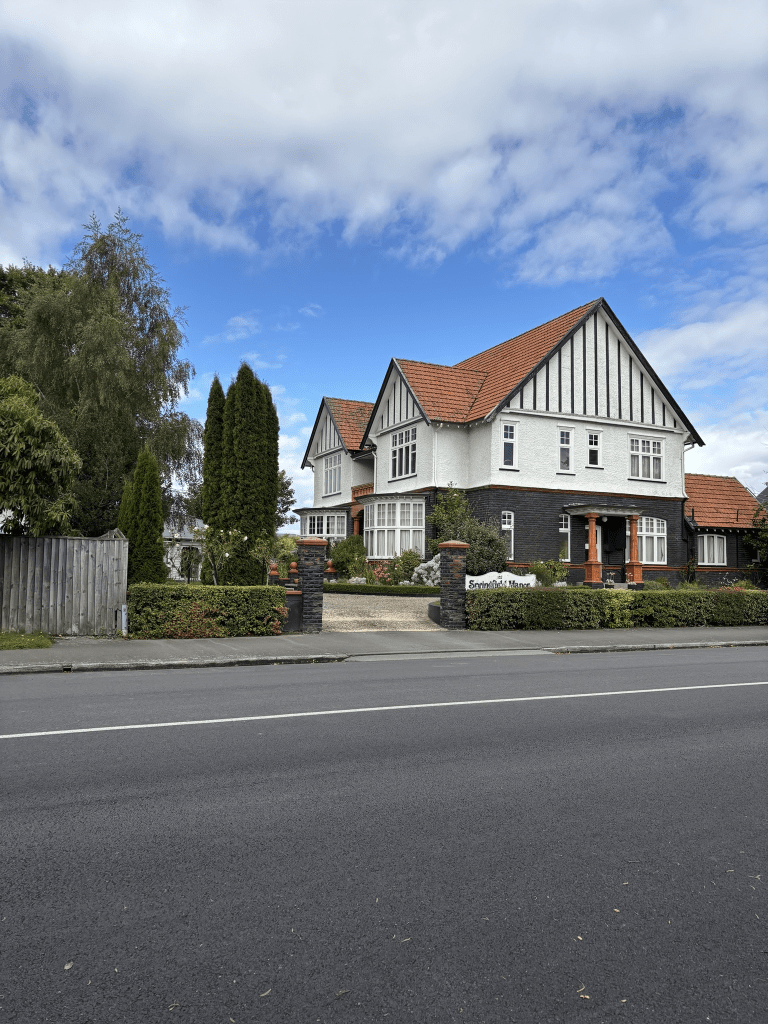
I walked this street last Wednesday when I went from WEA to my son’s house. There are nearly 300 houses on this street and they cover every decade from 1880 to 2023. Still a reasonable number of the older houses left and the most gorgeous one is called Springfield Manor. This house was built in 1910 for Robert English an engineer. Most of the older houses are in good condition and I wish that I had managed more photos. There were some really ugly modern houses. Many different styles of houses. Many of the houses were built between 1970 and 1990. Apart from houses there is a shop plus a couple of medical centres. There was a big building with a sign saying Empower. I hadn’t taken a lot of notice of this building thinking that it was related to the power company but it was actually a church. It was probably where the St Matthew’s Victory School/ St Margaret’s School used to be. I googled and the original building was demolished after the earthquakes. Apparently it is unknown what happened to the roll of honour boards from the school.
 Lytteltonwitch's Walking the streets of Christchurch Project