Studholme St in Somerfield – Duncan Street was incorporated into Studholme Street. Named after John Studholme (1829- 1903). Duncan Street was named after Thomas Smith Duncan (1821- 1884). Studholme, a lawyer, later became Crown Prosecutor. In 1857 he became the first representative of Timaru in the Provincial Council. He was a member of parliament 1867-1874 and 1879-1881. He married Lucy Ellen Sykes Moorhouse (1838?- 1926), a sister of William Sefton Moorhouse (1825-1881), in 1862. Studholme Street is first mentioned in the Star in 1906. First appears in street directories in 1907. Duncan, a lawyer, was a crown prosecutor. Duncan Street first appears in street directories in 1904 running off Somerfield Street. It was incorporated into and re-named Studhome Street on 1 September 1948.
A reasonable of information from the library website and I have just noticed their spelling mistake. John Studholme has a Wikipedia page about him so I don’t need to research him. Thomas Smith Duncan doesn’t have a Wikipedia page but Discover the Delights of Peeling Back History had the best information for him. Thomas Duncan started the firm Duncan and Cotterill which is still a legal firm. He was described as a bit of a rascal as he ran off with a young woman his employer had guardianship over. They were married at Gretna Green and then came to New Zealand.
I checked maps to doublecheck the streets and Duncan St on the various maps ran from Ashgrove Tce and across Somerfield St to meet Studholme St near the cemetery. Studholme St ran from Barrington St to Duncan St and this street was described as running parallel to the cemetery.
There was a reasonable amount of information on Papers Past but I did limit my searching to Duncan Street Spreydon and Duncan Street Somerfield as there was also a Duncan Street in Sumner and other towns.
In 1904 there was an ad for a missing dog. The dog’s name was Nemo so this appealed to my warped sense of humour. Lots of birth and death notices. There was one ad in 1909 that rather concerned me as the person was wanting to buy swords or bayonets. The street had several market gardens, a landscape garden, nurseries and poultry farms.
A Mr E T Horne owned one of the market gardens and in 1916 he managed to dig up a complete human skeleton in his garden. I don’t which end of Duncan St he lived but if it was the cemetery end of the street the skeleton could have escaped from there. Mr E T Horne had a son William and in 1917 William was called up for military service. William refused and put in for an exemption on the grounds that he was an American citizen. William Horne was born in New Zealand but his father was American. His argument was that he was automatically an American citizen because of his father but this was ruled invalid. He was a no show at the appeal board hearing as he had run off to America.
The rest of the information was a bit boring with a few ads and death notices. In 1948 the street was merged with Studholme St.
Studholme St had cheap sections available in 1905 plus between 1905 and 1910 there were many ads for sections and houses. Pine Farm in 1917 had potatoes for sale. The chickens in this suburb were everywhere as Studholme Farm had chickens. There was a case of polio in 1925. There was an obituary for Fred Cooke in June 1930. Nearby Cooke St was named after Fred Cooke. The obituary made a big thing about Fred using the cemetery as a shortcut even at night. It was noted that many men wouldn’t be brave enough to use the cemetery as a shortcut.
From personal experience it is the living and not the dead that you have to worry about in cemeteries.
There were still chickens for sale in this street in the 1950s plus plants for sale.
I walked this street on Sunday and I did it in a bit of a roundabout way as I walked it between Somerfield St and Ashgrove Tce. I then finished walking Somerfield St and went down Barrington St to rejoin Studholme St. This is too confusing so I will describe my walk as if I started at Barrington St.
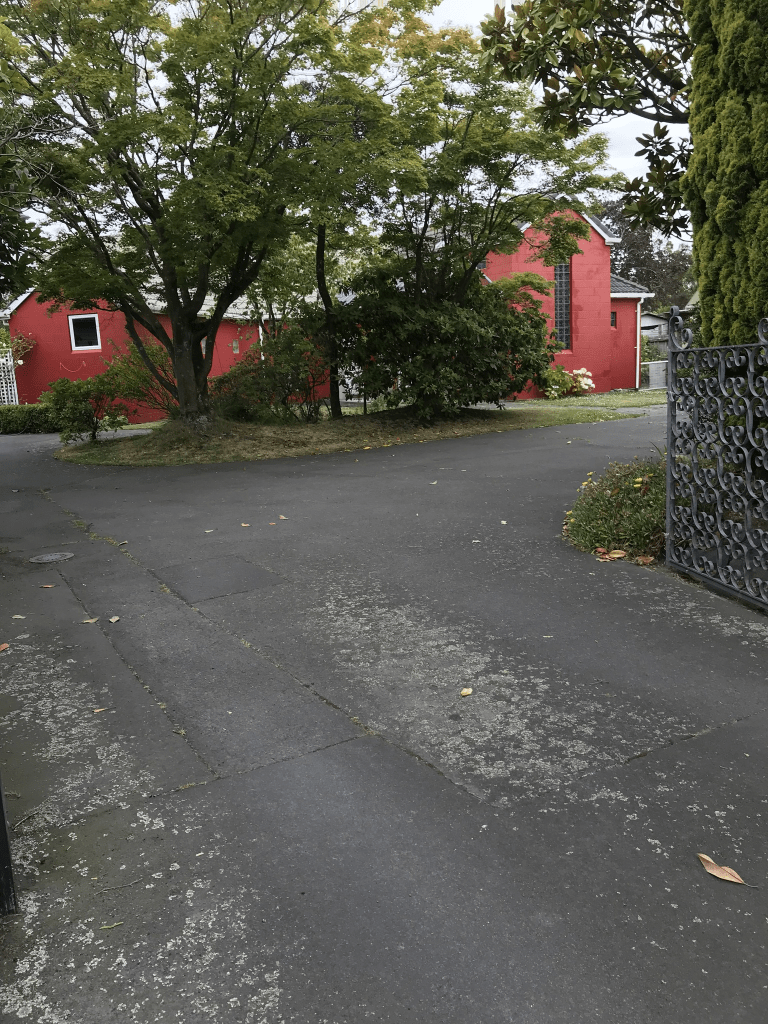
There are still many older houses at this end of Studholme St with a couple of modern ones in the middle of them. The modern houses look so out of place here. Almost opposite Somerfield school is the Somerfield Community Play Centre. The school takes up a fair portion of one side of the street and there is a little bit of street art on a building at the school. Opposite the school as well as the Play Centre there are more houses. On the sharp bend there is Somerfield Park and I took photos of the toilet block. It had street art on it. It is this corner where it would have been two separate streets until 1948. Walking towards Somerfield St I am walking where Duncan St used to be. Still some lovely older houses here with some 1980s houses amongst them. One house had a very overgrown garden and makes my garden look almost tidy in comparison. I cross Somerfield St and there is the same mixture of older houses and ones from the 1980s. There was a bright red house and I thought that it was an old church at first but I was wrong. About half way down there is a big empty section where state houses have been demolished and they will be building new ones. I believe that 6 units will be built where there used to be one house. This is a pleasant tree lined street but it was rather windy when I was walking here on Sunday morning and there was at least one tree branch on the ground. I had a brief chat with a local and she said that the wind had damaged some of her plants.
There were nearly 40 older houses on this street built between 1905 and 1920 and most looked in good condition. The next big lot of houses were all built in the 1980s with only a few built in the other decades.
 Lytteltonwitch's Walking the streets of Christchurch Project